October 7, 2024 By Maria
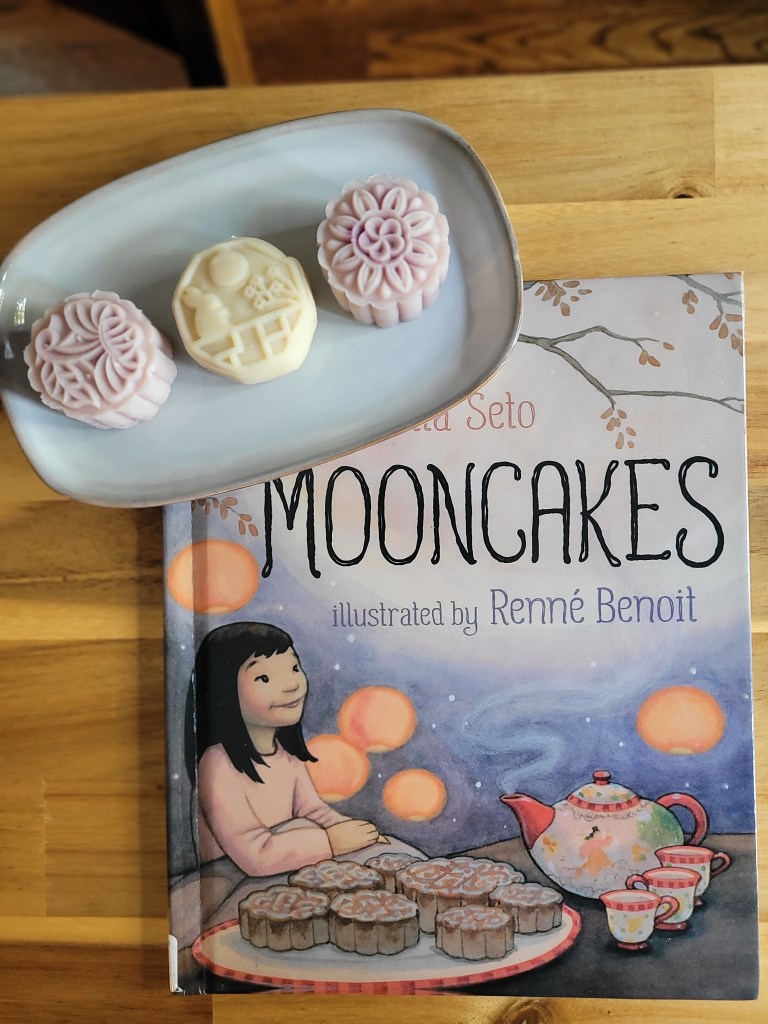
Here I am continuing my Mid-Autumn Festival short series. As I described in my previous post, the Mid-Autumn Festival is an Asian harvest holiday of family togetherness. The books I write about here center on the myths surrounding the festival. In Chinese Mid-Autumn celebrations, the myth of Chang’e and Hou Yi takes center stage. While staring up at the moon, grandparents and parents often ask children if they can see the lady or rabbit on the moon. My kids love doing this.
As the story goes, once ten suns took turns crossing the sky each day. One day the suns decided to all travel together across the heavens. The earth burned and the people called out in fright and supplication. An archer, Hou Yi, took his bow and shot down nine of the ten suns, saving Earth. The celestial beings blessed Hou Yi with a gift, the elixir of immortality, which he and his wife, Chang’e hid in their home. When Chang’e was alone in the house, an evil man broke in and tried to steal the elixir. Chang’e drank the entire flask to stop him; after which she floated up to the moon as an immortal being. She would stay forever on the moon in the company of the Jade Rabbit (whose story is for another time). Hou Yi was devastated at his wife’s disappearance but noticed her familiar shadow on the moon’s landscape. After that, every year on the anniversary of her departure, Hou Yi would sit at an outdoor picnic with Chang’e’s favorite round cakes (mooncakes) and gaze up at the moon while Chang’e lovingly shined the moon’s bright light down on Hou Yi.
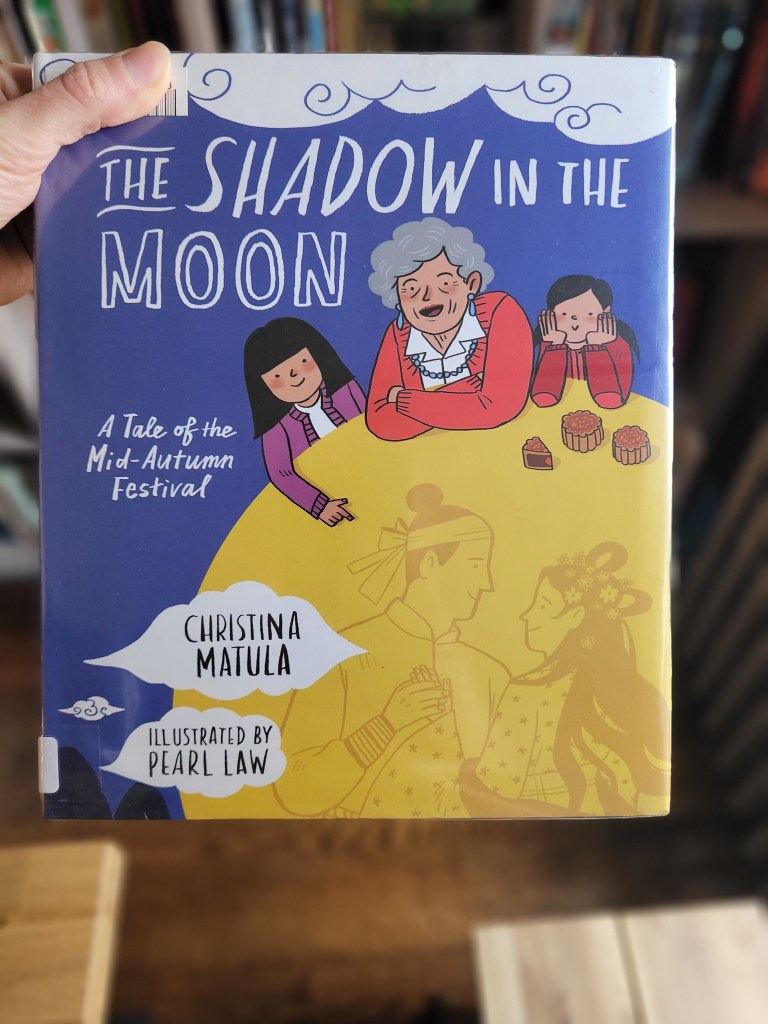
The first book contains a beautiful version of Chang’e and Hou Yi’s tragic love story. It is written by Christina Matula, a Canadian-born Taiwanese and Hungarian author. It is illustrated by Pearl Law, a Hong Kong illustrator who works in multiple art genres. Christina Matula has also written a second Mid-Autumn Festival book; it is about a girl of multicultural background finding her unique way to celebrate the Mid-Autumn Festival. The Shadow in the Moon: A Tale of the Mid-Autumn Festival by Christina Matula remains our favorite retelling of the tale of Chang’e, the Lady in the Moon, and her beloved husband, Hou Yi. At a family’s moonlit banquet the grandmother, Ah-ma, tells their story to her two granddaughters. The story inspires one of the granddaughters to wish on the moon for wisdom and kindness. I liked how this book focused on the family coming together and a young girl being inspired to do good and seek self-improvement. There is also a mooncake recipe at the end of this beautiful story.
Beautifully illustrated by Renné Benoit and written by Loretta Seto, Mooncakes occurs during a family’s moonlit picnic. This book artfully mixes fairytales with family togetherness. The young girl in the story shares mooncakes and tea with her mother and father as they tell her various legends about the moon. I like how this book shares more than just the story of Chang’e; it also covers the stories of Jade Rabbit and Wu-Gang. One difference that the kids and I noticed is that in this version of the myth Chang’e and Hou Yi do not have a loving marriage. In this story, Chang’e drinks the magic tonic to save the world from Hou Yi’s cruelty. Even though we didn’t like that version, it allowed us to discuss the story’s variations.
Another variation I would like to bring up is Ten Suns: A Chinese Legend retold by the reteller of many myths, Eric A. Kimmel, and illustrated by Yongsheng Xuan. When I read this book as a kid, I was captivated by the beautiful illustrations and the horror of how the world’s salvation manifests by the slaying of nine of the ten suns. The suns in this book are personified as the young sons of the Eastern Emperor of the sky. The arrows do not kill the suns but transform them into birds. As a child, I felt the bird transformation was almost as bad as dying. I felt hesitant about reading this book to my kids. I worried it would bother them the way it did me. However, I also thought it was an opportunity to discuss another variation. I had to remind myself that a story does not affect everyone the same way before I read it to them. This book tells the story of Hou Yi and how he saved the earth, but it leaves out Chang’e and instead focuses on the ten suns. My kids were not scared or scarred. It turned into a good experience for us to read this story among the other Mid-Autumn Festival books.
Since childhood, I have always enjoyed reading different versions of fairy tales or myths from all over the world. I also remember asking my mom to tell me certain stories like Little Red Riding Hood, over and over. The other day my daughter asked me to tell her the story of Chang’e, so I did. Then she asked me to tell her the story of the Jade Rabbit and “the one where the suns are little boys.” I hope she remembers these times when she’s older. I love how some Chinese myths are in my kids’ repertoire of requested stories. I hope you enjoy learning more about the Mid-Autumn Festival and make beautiful memories.
 More Bookshelves Please