Just in case you missed anything, I put together a list of the books I wrote about in July. At the end of each month (or later, as in the case of this post), I will write a list of all the books I wrote about during that month. The post titles will link back to the original blog posts.
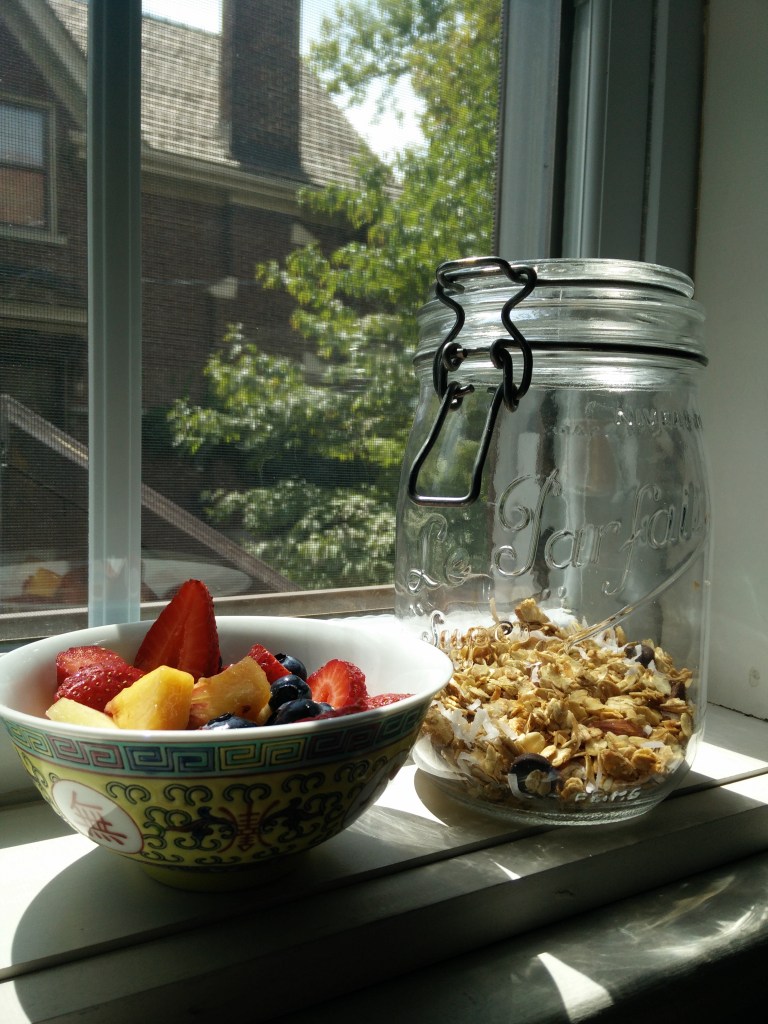
My daughter loves strawberries. Well, all my kids do, but especially my daughter. . . and me. We will eat strawberries whole, cut up, with yogurt and honey, cereal or granola, on waffles, on ice cream, in dessert, and so on. My personal favorite fruit combination is strawberries, blueberries and peaches. Yum! One year, after watching some videos online, I decided we would try to grow our own strawberries from seeds saved from the berries we ate. That project was a complete failure, but last year I bought a couple plants, which gave us about five berries last year. They survived winter and we hope to get more strawberries this season. According to friends, who have successfully grown strawberries, the first year gets very little berries.
Strawberries, blueberries, & peaches, yum!
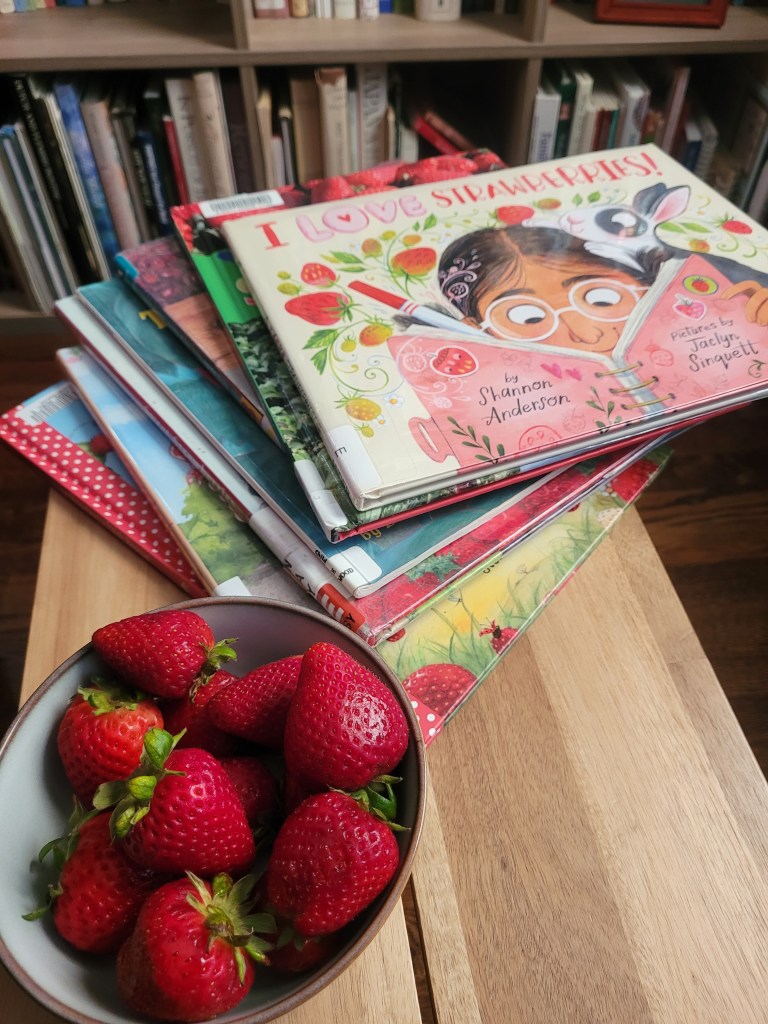
The first time we attempted to grow strawberries, we also listened to a podcast episode about strawberries, which inspired our homeschool strawberry unit study that year. (At the end of this post I will include some links with information I referred to when putting together our strawberry unit study). When I decided on the unit study, of course that meant I needed to find strawberry books. I didn’t know of any strawberry stories, so it took some googling, library catalog searching, and investigating unit study plans that teachers and homeschoolers had shared online to find our pile of strawberry books. Today, I’d like to share a couple of books from my strawberry book stack.
First from the stack is a nonfiction informative book called Grow Your Own Strawberries by Helen Lanz. This book is packed with information and photos which not only tell you how to grow your own strawberry plants but also how the strawberry plant grows and develops. By reading this book we learned that even if our seed experiments sprouted it would take a whole year for us to get any fruit from our plants. That was a disappointment, but it didn’t stop us from learning about and eating strawberries as we learned more about berry cultivation.
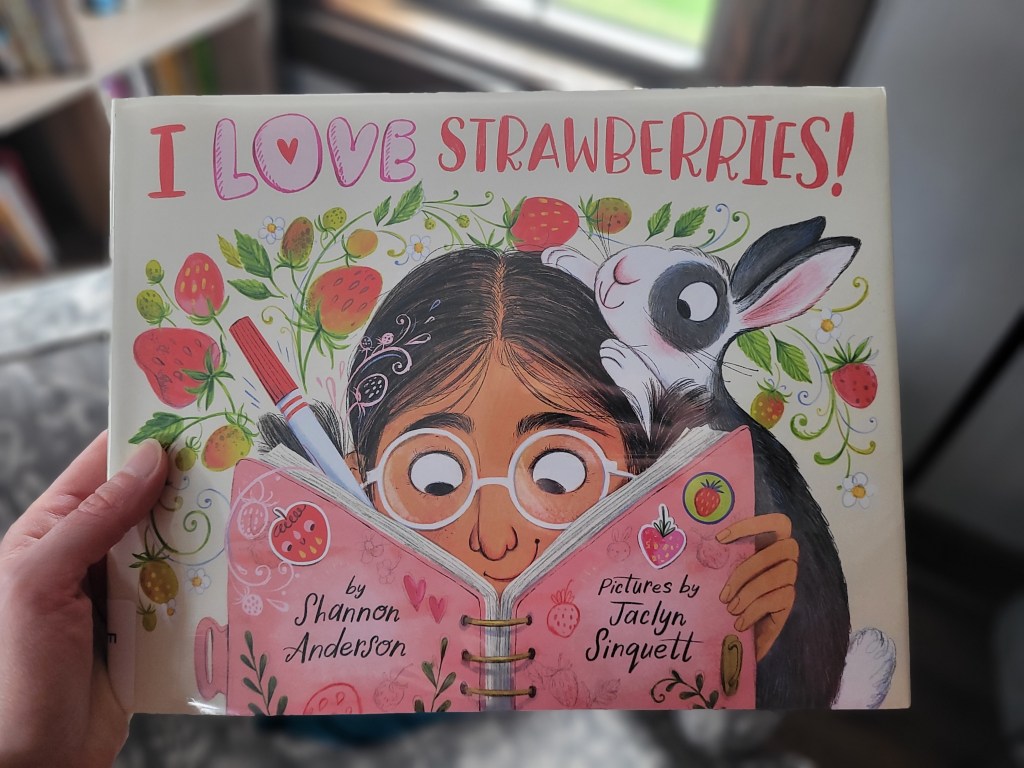
While cultivating my list of strawberry books, I discovered an instant favorite: I Love Strawberries by Shannon Anderson and illustrated by Jaclyn Sinquett. This book tells an endearing story of a girl, Jolie, who wants to grow her own strawberry garden. I enjoyed her antics and strawberry journal entries that are included in the book. In the illustrations we see that Jolie is biracial. I like how this isn’t the focus of the story, just a natural part of it. My husband is Chinese American and I am Caucasian, so I am always happy to find a book like this. I appreciate the way mixed racial families are normalized, not stigmatized in this book. We learned about strawberries and loved the story, too. My daughter was very impressed and excited by how many strawberries Jolie was able to grow.
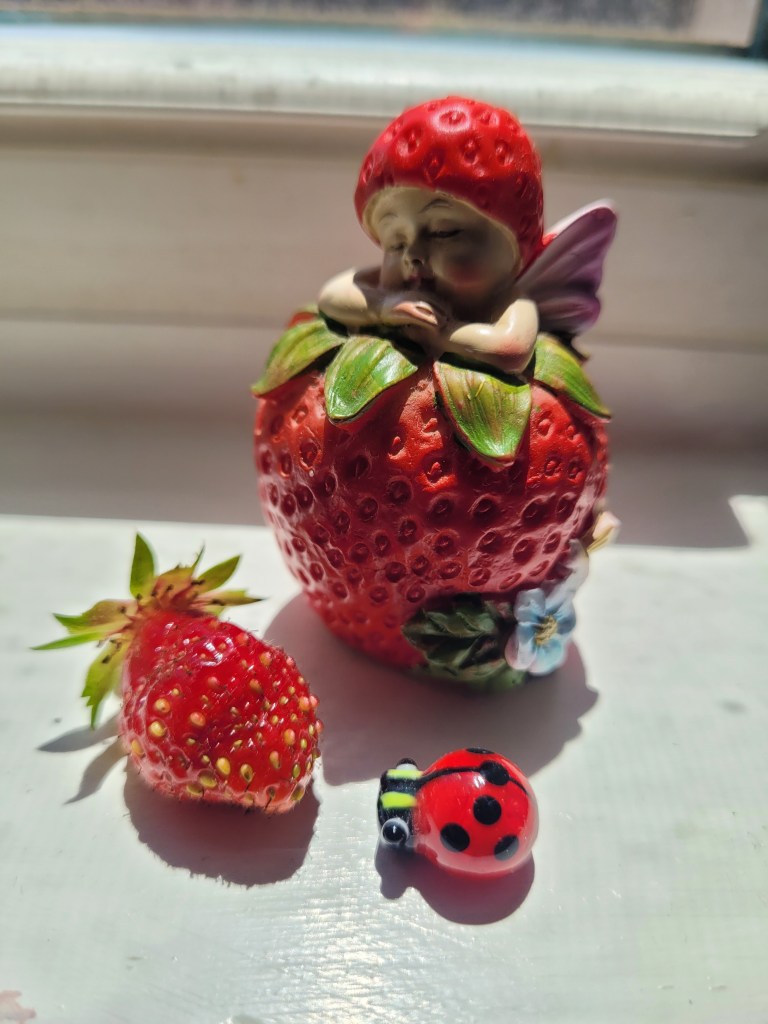
Our first strawberry of the season with the strawberry fairy, of course
We are somewhat patiently waiting for our strawberry plants to bloom this year. The very first teeny tiny green berry just started in early May. We have had seven berries so far this year. My daughter and I had so much fun with our strawberry unit study and we are still enjoying the process of growing our own strawberries. (Though we do wish the plants would grow a little faster.) I am grateful for how much I learn while teaching my kids and how many times picture books have surprised me. I have learned quite a lot from picture books over the years. What have you learned while reading to a kid?
Just in case you missed anything, I put together a list of the books I wrote about in May. At the end of each month, I will write a list of all the books I wrote about during that month. The post titles will link back to the original blog posts.
Before I was born, my parents lived in a different house. Their neighbor was a beekeeper. I remember hearing the stories when I was a little girl; Stories about how delicious and sweet the fresh honey was and how the bees buzzed about the garden.
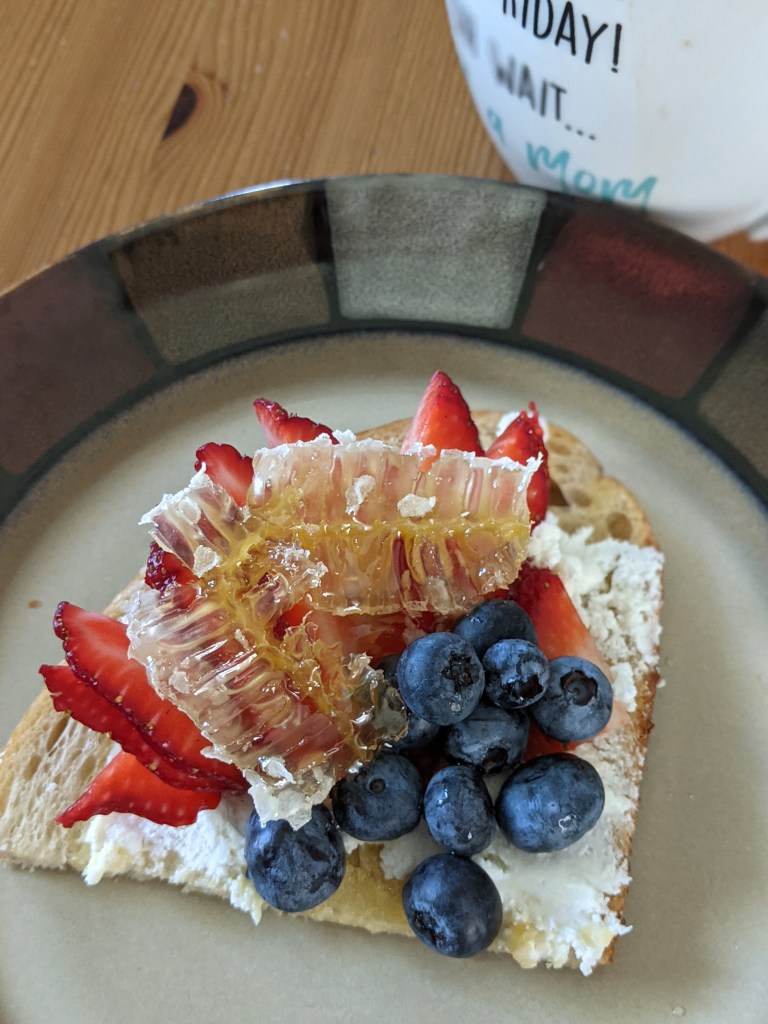
Delicious honeycombs and fruit on toast!
My memories of these stories formed a beautiful glowing image in my mind. It’s what I still picture when I think of honey and bees. I imagine a garden lit with warm golden light and filled with beautiful flowers. I see bees flying about through the flowers and in and out of their hive and I think about the delicious taste of honey drizzled on toast or yogurt. This mental image gives me a refreshing feeling of comfort and childhood memories.
As a child I knew this elderly couple and fondly remember visiting them at their home. I remember feeling awe and a bit of fear while cautiously watching the bees and their hives from a distance as they buzzed about the garden. I loved honey and thought bees were interesting, but I was afraid of being stung.
When my oldest son was small, he was very interested in studying insects, but not too fond of them up close. He is still not a fan of bugs, but he handles it much better now. When he was smaller, his fear of bees (and bugs in general) started to deprive him of experiences that were outside. This led me to explore many picture books about insects and spiders to help him with his fear.
Now my oldest son is comfortable enough with insects to actually come near and observe them closely outside. He even tried catching a cabbage moth in a butterfly net a couple years ago. (To be completely honest, he did run away after placing the net over the moth. However, he did want to find a bug observation jar for me to put the moth in). Don’t worry, we couldn’t find the jar and shortly released our moth who flew happily away.
Dealing with my child’s fear of bugs led me to read so, so many bug books! I would love to start listing them here, but “The Young Entomologist’s List of Picture Books” will be a post for another day. Today the focus is bees. I think the spring weather with blooming flowers and breakfasts of granola with yogurt and honey are my main inspirations for writing this now. Besides spring being the perfect time to read about bees today, May 20th, is also World Bee Day. So, on this day during the bees’ favorite time of year, let’s read about bees!
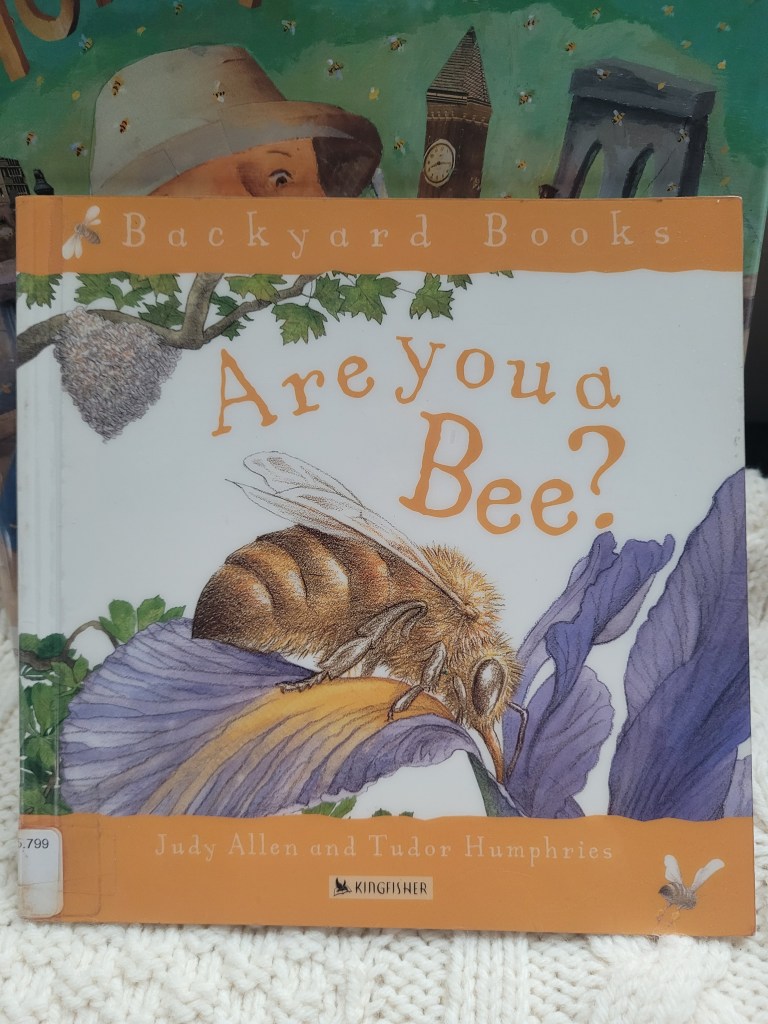
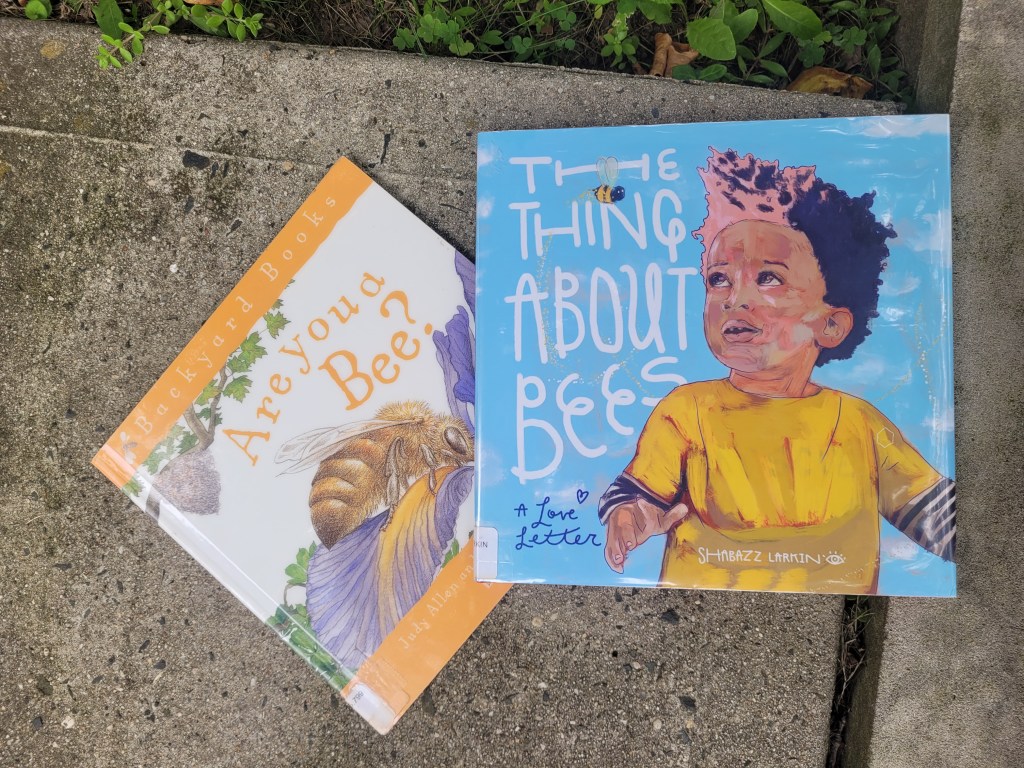
One of my favorite picture books about bees is called Are You a Bee? by Judy Allen and illustrated by Tudor Humphries. (Judy Allen and Tudar Humphries actually created a series of books like this called the Backyard Books). This book immediately engages the reader by asking, “Are you a bee?” and goes on to explain all the things the readers would be doing if they were bees. Not only does this introduction quickly get kids’ attention, but it produces (at least for us) a few giggles too. The illustrations are precise and delicate. I discovered a few new things about bees reading this book to my kids.
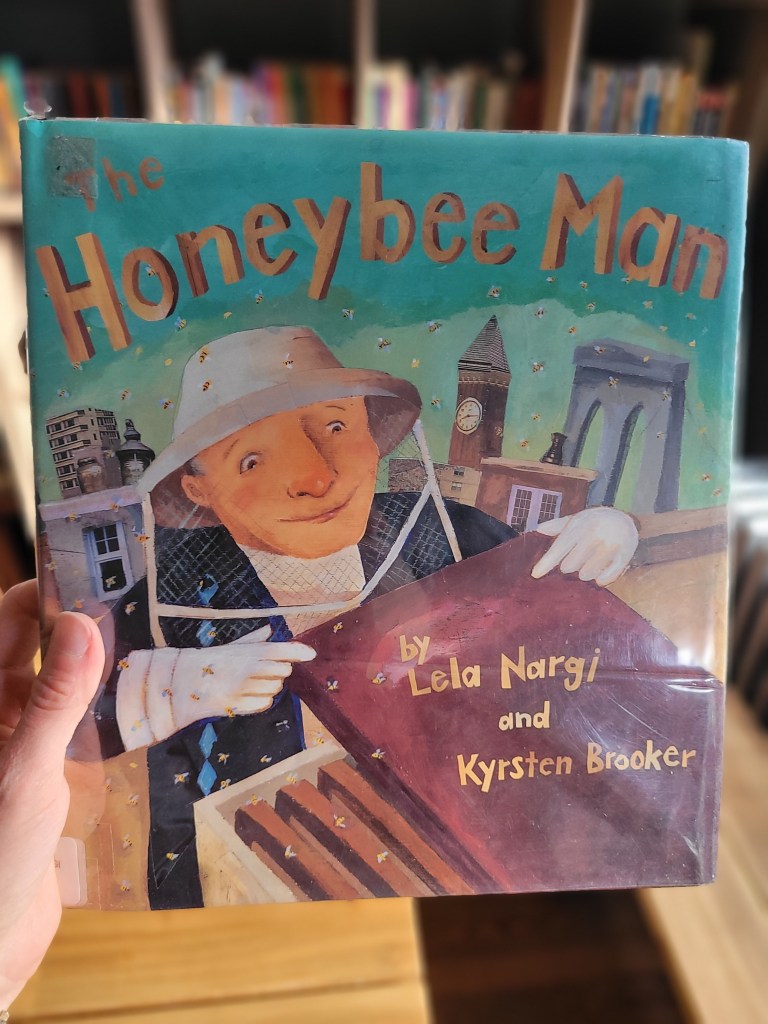
Can you imagine discovering a rooftop beekeeper in the middle of a city? That is exactly who you will meet in The Honeybee Man by Lela Nargi and illustrated by Krysten Brooker. (My husband and I recently finished watching Elementary, a contemporary reimagining of Sherlock Holmes from the 2010’s. One recurring aspect of this show was Sherlock’s rooftop bee hives, which always made me think of this book). Not only is The Honeybee Man a charming story about a man named Fred and his bees and animal friends, it is also a tale of kindness, generosity, and community. The book teaches some basics about honey harvest and preparation and tells us how bees work together and search for nectar from all parts of the city. The neighbors enjoy Fred’s honey and love hearing how the bees made it from all the flowers in their neighborhood.
While kids may love honey, many kids have a fear of bees and being stung. A fear of bees is the exact reason Shabazz Larkin wrote his book, The Thing About Bees: A Love Letter. I appreciate how this book touches on the important part bees play in the ecosystem. At the end of the book, Larkin has a note about his own fear of bees which he did not want to pass on to his children which is why he made this book. The Thing About Bees definitely reads as a love letter from a parent to their kids and bees and draws cute comparisons between bees’ and kids’ behavior. The Thing About Bees might not be the most scientific or informative bee picture book, but remains a beautiful work that is not to be overlooked and may be just the thing to help a child start to take a more positive view of bees.
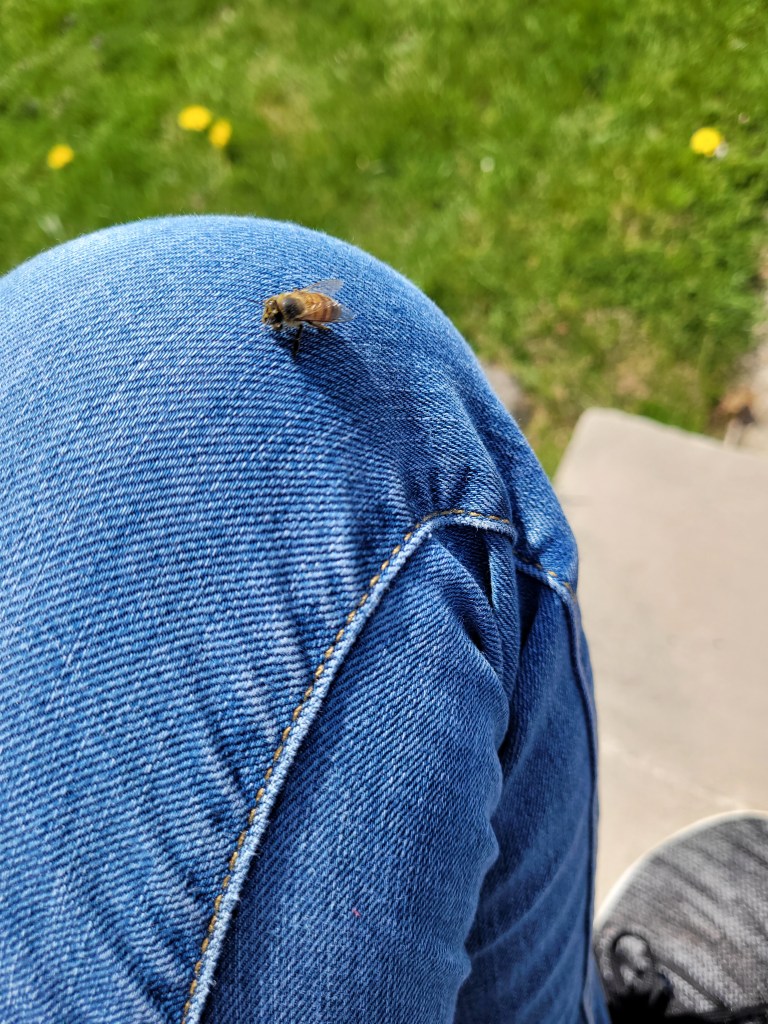
A little bee came over to say hi when we were outside
I hope more kids develop a positive mindset toward bees and insects in general. I understand that maybe they or a friend or family member were stung by a wasp or a bee. . .because they perhaps stepped on the bee. . . (That would be me. I highly recommend wearing shoes in a clover patch.) . . . or they were bitten by a mosquito. . .or a few hundred of them. (Summer is coming! Time to find the citronella!) Regardless of the fear, it is important to learn about and care for these tiny helpers who pollinate our plants and share their delicious golden honey with us. My hope is through learning we can conquer or at the very least help lessen the fear. Playing outside is so beneficial to children’s growth and development. I do not want fear to rob my son or other children of the chance to play out in the fresh air and to have other great outdoor experiences. Encourage little ones to search for bees and insects and spiders outside with the reminder to observe and not touch. Be kind to the bees and Happy Bee Day!
Just in case you missed anything, I put together a list of the books I wrote about in April. At the end of each month, I will write a list of all the books I wrote about during that month. The post titles will link back to the original blog posts.
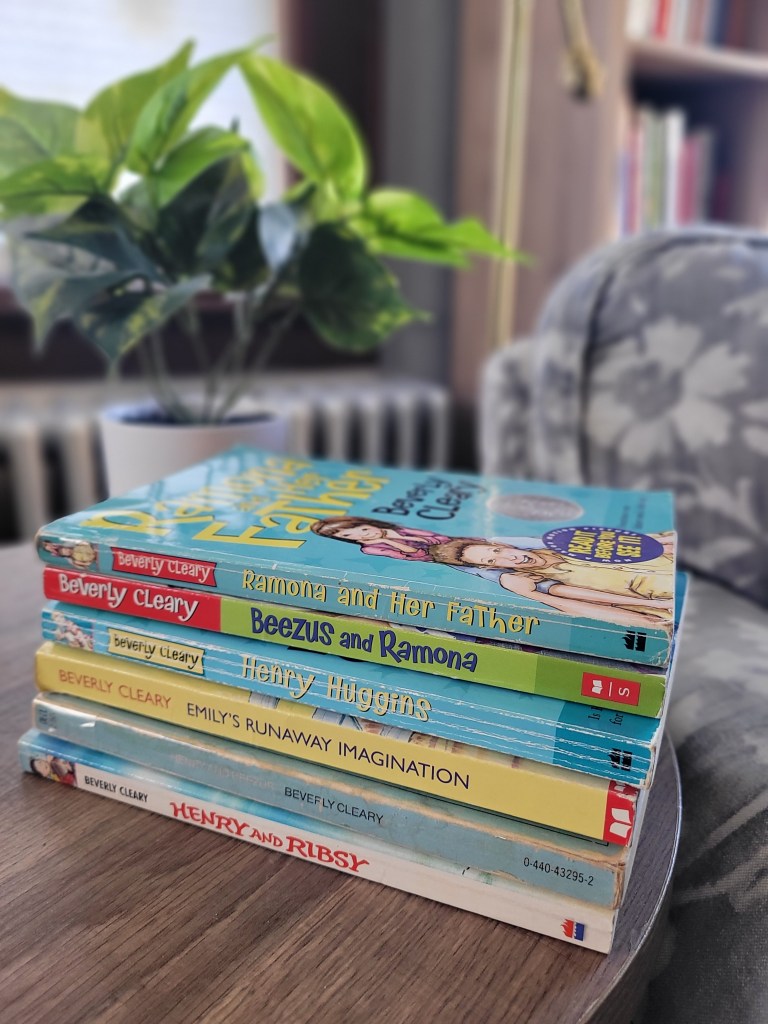
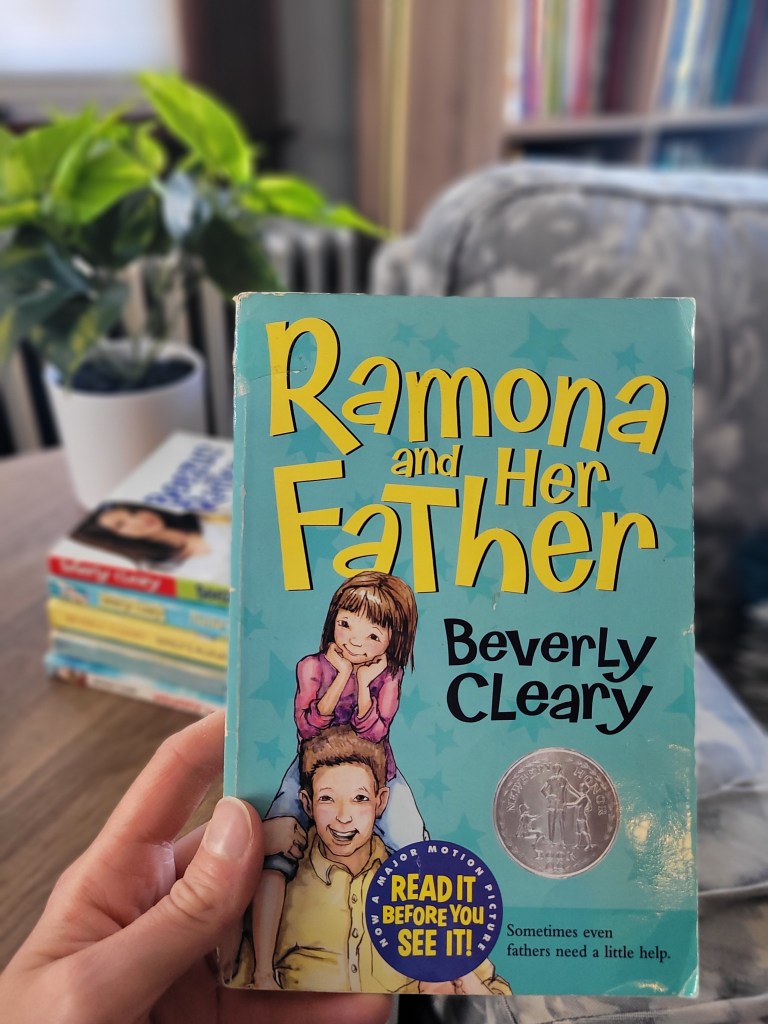
Have you read a book and thought that’s so funny because it’s true, and then paused as you realized, oh it is true. . .I had that experience when I read the Ramona Quimby books by Beverly Cleary.
Today, April 12th, is D.E.A.R. Day and the anniversary of Beverly Cleary’s birthday. D.E.A.R. is an acronym for Drop Every And Read that started in 2006 in honor of Beverly Cleary’s 90th birthday. Cleary passed away in 2021 at the age of 104. Check out this photo of her here on her website. I can imagine Cleary smiling sweetly like that while watching kids read her stories still today.
My first introduction to Ramona Quimby, one of Cleary’s iconic characters, was when I watched the 2010 Ramona and Beezus movie with one of my best friends. She was very excited to see this movie, but I had no idea what it was about. I did end up enjoying it then and even more when I rewatched it years later with my kids. By then I had discovered the lady behind Ramona, the author: Beverly Cleary.
Beverly Cleary was a mother and librarian in Oregon who decided to write books for ordinary kids about ordinary kids and she never went back. The children in her books are so alive! They are mischievous and imaginative, they get into trouble, they struggle and they have fun. Their world is our world. I did not read any of Cleary’s books until I was an adult and a parent. I know this influenced my appreciation of her work. The kids in her books and their antics reminded me so much of my own kids and others in my life. The characters are so real to me.
Back around five years or so, I started listening to the Ramona series audiobooks in the car with my kids. They were delightful and made me laugh out loud and sigh. I was almost more invested in the story than my kids.
In Ramona and Her Mother, Ramona squeezes out a whole family sized bottle of toothpaste into the sink in order to sculpt a rosebud cake. I was laughing at the realness of this scene. Since I could definitely imagine a couple of my kids doing this, it was doubly funny to see the look of horror on their faces as we listened to this part of the book. I do have to credit Ramona’s mother, she handled the whole situation very well. I probably would have reacted more like Beezus, at least initially. During the toilet paper shortage of 2020, my four year old, in his attempt to use the bathroom independently, unfortunately used up almost a whole roll of toilet paper at one bathroom visit. This was definitely a similar Ramona moment for me. I was annoyed, but Cleary helped me appreciate the humor in that moment and handle it with more grace.
While my kids saw the actions of Ramona as very naughty or maybe even scary, I could see Ramona’s curioustity and how she acted without thinking, like a child.
My kids felt sympathetic when Ramona’s boots got stuck in the mud in Ramona the Pest. I was able to see the funny side of the situation. I had rescued them from equally “dire” and hilarious situations, such as getting stuck in the shelf of a side table. My kids were almost surprised I found Ramona getting stuck in the mud funny.
When Ramona attempts to run away in Ramona and Her Mother, my kids were surprised and worried. I found their reaction amusing because I have heard that threat from them at different times. The most memorable was when my son was four. He decided to run away after becoming frustrated that we didn’t understand the rules to a game he had just invented and refused to explain. He never got as far as packing, because when I gave him a list of supplies to bring and suggested he should probably think of shelter, like the homes the little pigs make since he was heading out on his own in the world, he decided running away wasn’t the best idea. Mrs. Quimby’s overpacking of Ramona’s suitcase to make it so heavy she couldn’t get far was definitely my next plan of action if just talking to my son didn’t work.
I discovered Beverly Cleary as an adult. I don’t know why, but I never ran across any of her books as a kid. While my kids listened in almost horrified silence to the creative antics of Ramona Quimby, I was bursting at the seams with laughter. My kids are mature enough now to distinguish their own emotions from those of fictional characters so they can now more openly appreciate the antics of characters like Ramona.
I don’t think I could have appreciated these books to their full extent before becoming a parent. I have to thank my younger two kids for that. They team up for all sorts of adventures and unintended mischief. This month give yourself some D.E.A.R. time. Drop everything and read for thirty minutes, or even ten. Read aloud to a kid or read silently in quiet peace. If you have never given Beveryly Cleary a try, maybe pick up one of her books this month and see what characters you will meet. Just read!
Better late than never! Just in case you missed anything, I put together a list of the books I wrote about in March. At the end of each month, I will write a list of all the books I wrote about during that month. The post titles will link back to the original blog posts.
When spring brings warm weather, we always rush outside, throw open the windows, and shed our coats. My kids come home from school and dig through their drawers for summer weather t-shirts and shorts. The next day they will lament the return of cooler weather or rain. Spring weather remains a fickle surprise.
One thing spring is not fickle about, is flowers. Gardens will bloom. They may be late. They may be early. Whenever spring lets it happen, gardens bloom. One of my favorite things about spring is the surprise of finding new things growing as the snow melts. Little surprises greet us each day like the first spring crocus poking through the bare ground.
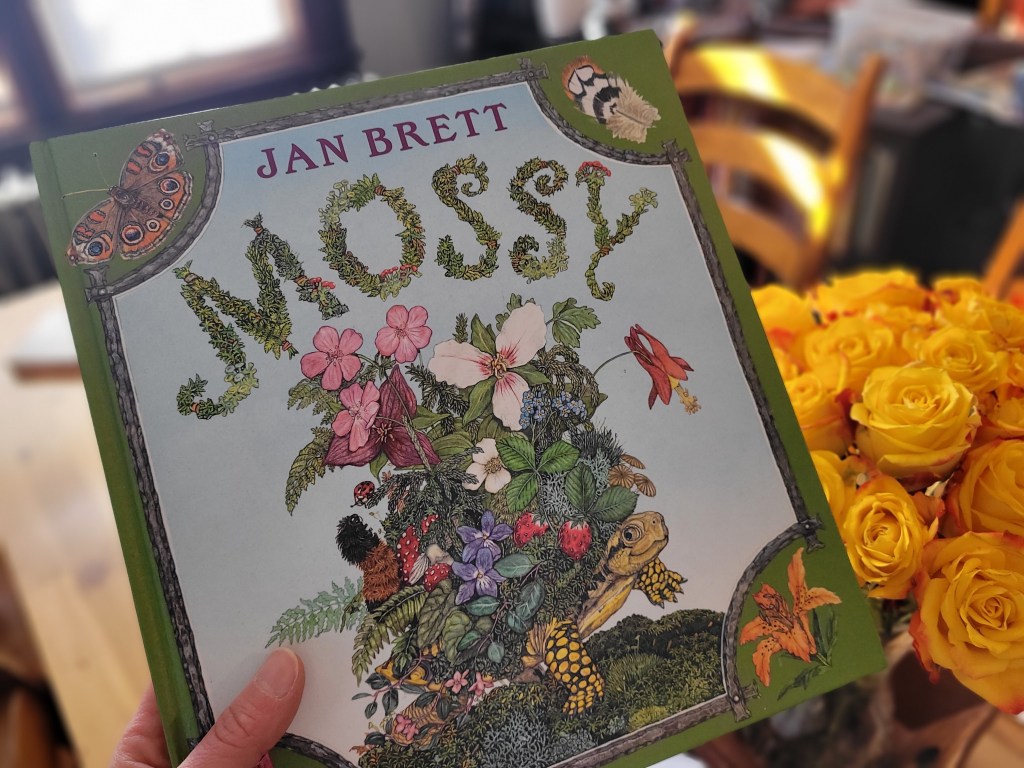
Around the time I started putting my blog together, my husband surprised me by coming home with a picture book after grocery shopping. The book was Mossy by Jan Brett. He knew I liked Brett’s work and had not read this book. The kids thought he bought it for them, but I knew better. I thought it was incredibly sweet of him.
Mossy is a story about a little turtle on whose shell a small garden grows. Mossy loves her little garden and the surprises it brings from new flowers to wild strawberries until one day she sets eyes on a handsome turtle named Scoot. Sadly, Mossy is scooped away by Dr. Carolina and her niece, Tory. Dr. Carolina gives Mossy a beautiful and comfortable new home in her museum, but Mossy misses her real home and Scoot. After a question from Tory makes her consider things differently, Dr. Carolina gets a wonderful idea for how to share Mossy and her lovely garden with the world while also returning Mossy to the wild. Mossy is so happy when she reunites with Scoot.
One thing that always makes me happy when I read Jan Brett’s books is looking for new surprises in the border art. Her books are full of fun detail hidden in border illustrations and Mossy is no exception. There is so much to take in visually when I read Brett’s books with my kids, that we either read very slowly or go through the book a second time immediately after finishing just to look at the pictures.
When Mossy’s story finishes, Tory is grown up and Mossy is a happy old turtle. In the border illustrations, we can see Tory bringing her own children down the banks of the grove to see Mossy and her family by the pond. I love seeing Mossy and Scoot’s children with their own shell gardens just starting.
Just like flowers we plant in the garden, good stories can be planted in our hearts when we read them. The stories grow like little flowers in our souls. They shape us little by little – the people we spend time with, the places we frequent, the stories we read and watch. I love seeing small blooms and buds of good stories blossom in my kids. It might be the way my son uses a story to help relate to and understand something difficult in life. Or it might be the way my daughter says she feels happy just like a character in a book who’s overcome a difficulty. In whatever way they manifest, these flowering surprises are lovely to experience.
Of the many ways I keep warm in the cold, sweaters and hot tea are my favorites. The next favorite isn’t exactly logical, but it is delightful: cozy books. Books that make me feel warm inside like a comforting hug, fill this category.
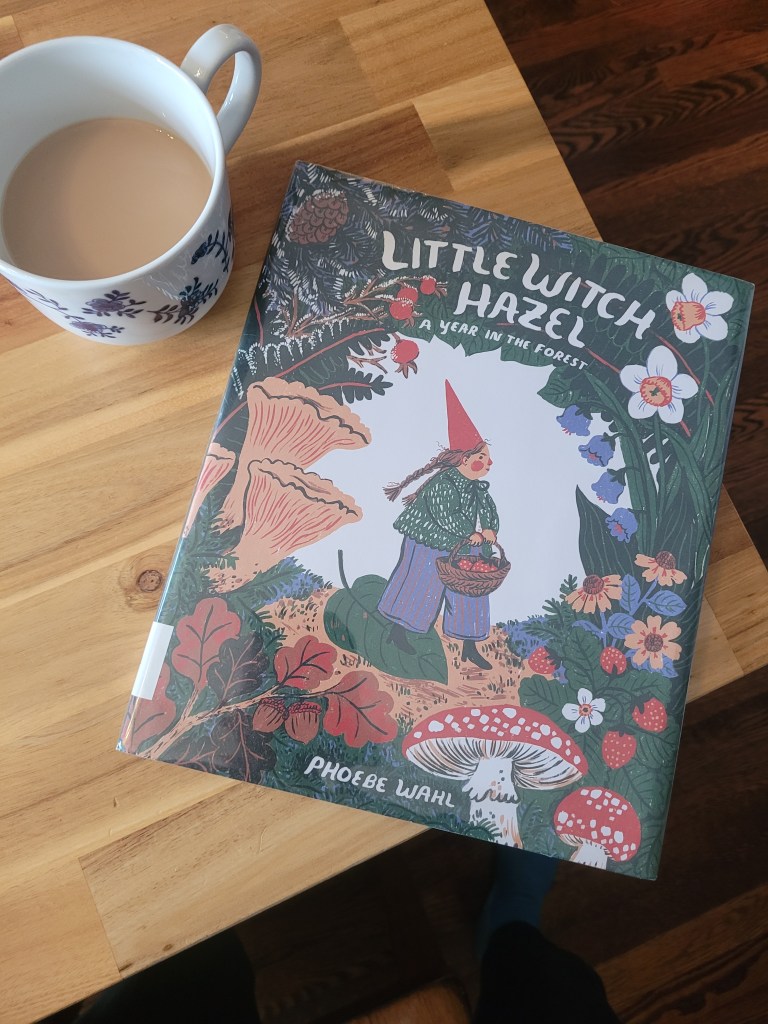
One of my favorite cozy picture books I read over the winter was Little Witch Hazel: A Year in the Forest by Phoebe Wahl. I don’t know what it is exactly about this tiny “witch” who lives in a moss-covered tree stump in the woods, but reading this book feels like a toasty blanket and warm drink during a rainstorm. Hazel is a minute figure who goes about her simple life throughout the seasons in the forest. During the spring she brings an orphan egg home to tend. An owlet hatches from the egg and quickly grows too large for her small house and finally flies off to join other owls one evening. My kids were sad when this happened, but they were so happy for Otis’ surprise return before the end of the book. As the seasons progress, we learn more about Hazel and her simple and comforting life.
During the summer Hazel learns a lesson on relaxing, letting go, and being in the moment. When she finally decides to enjoy the day, wonders await her. In Autumn, Hazel plays detective and overcomes her fear while solving a mystery for her forest friends. When winter comes, Hazel works hard tending to the ill creatures of the forest. Thankfully, a friend is nearby when Hazel is in desperate need of care herself.
Maybe it is the caring community Hazel is surrounded by that makes this book so warm and cozy. It could also be the watercolor illustrations and the tiny creatures that fill the pages. The book is imaginative and a pleasure to read. When we last borrowed it from the library, I read it to my kids first and then I read it again once or twice with a cup of tea in hand and a cozy blanket draped over me and a private smile on my face as I enjoyed the warmth of Hazel’s forest life.
Last Sunday a friend texted me a happy international women’s day message. That made me think, this is the perfect week to post this Jane Austen piece I have been working on.
In typical fashion of this blog, my Jane Austen post is late, later than I planned at least. Originally, I wanted to post this on her 250th birthday anniversary, but life had other plans. Over the spring and summer of last year and especially this past December, people around the world have been celebrating Jane Austen’s 250th birthday anniversary. On December 16, 1775, Jane Austen was born. She was the youngest child and second daughter in the family of a countryside English clergyman. Jane grew up in a time of many restrictions on women, but in spite of her times she had a thorough education and became an accomplished author.
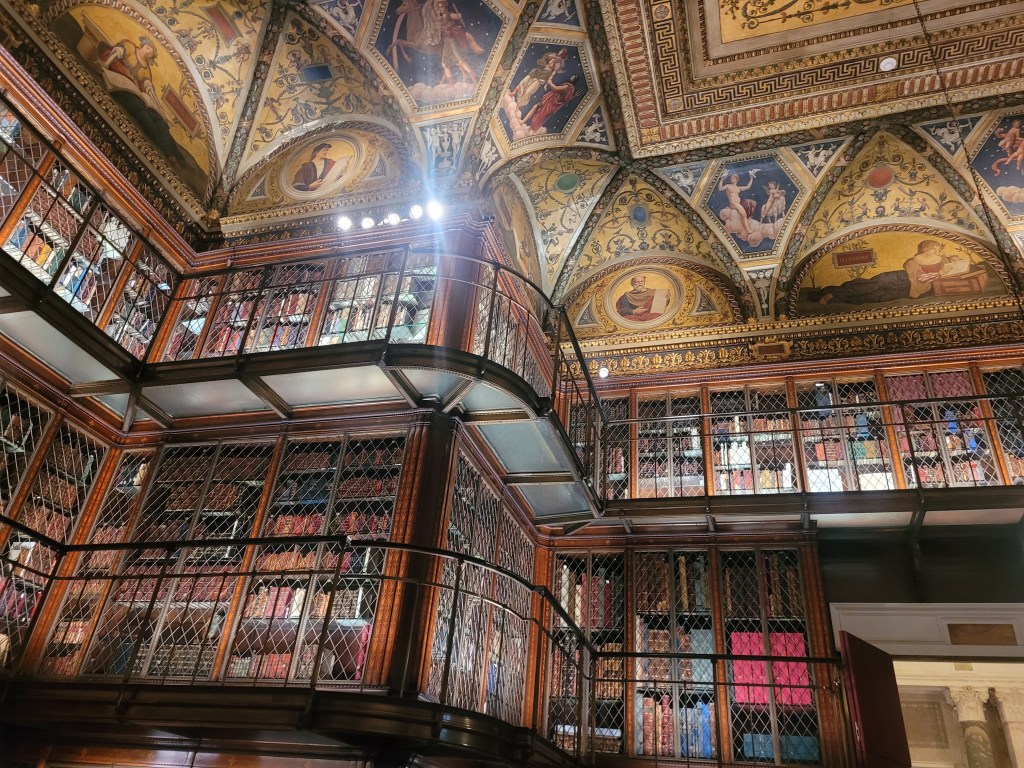
My favorite room at the Morgan Library
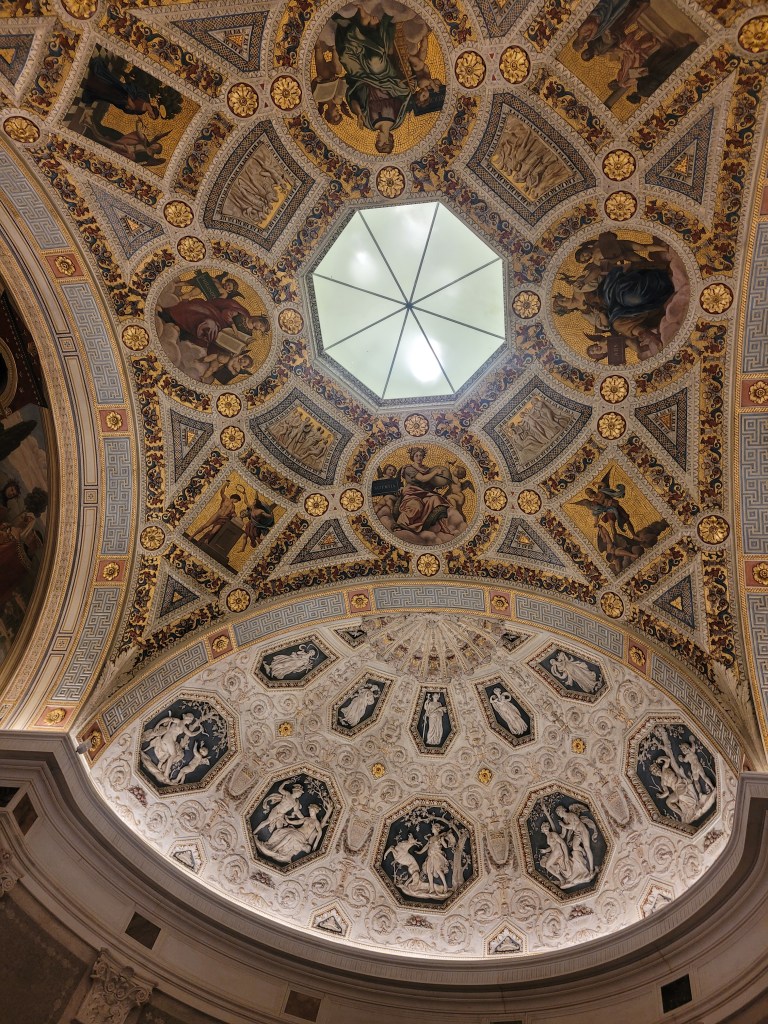
In August, my husband and I traveled to New York City with a friend to visit the Morgan Library to see their Jane Austen display in honor of the author’s birthday anniversary. The Morgan Library is now a public museum, but it was once the private library of J. P. Morgan, one of New York City’s Gilded Age Elite. Years ago, I listened to a historical fiction novel, The Personal Library, about the life and work of Belle De Costa Greene, an African American woman who procured and managed Morgan’s library collection. It was spectacular seeing the architecture, art and books I had heard described in such detail in the novel. Our first visit to the Morgan Library was to see the Beatrix Potter show in 2024 (that was also an amazing experience).
Ceiling details at the Morgan Library
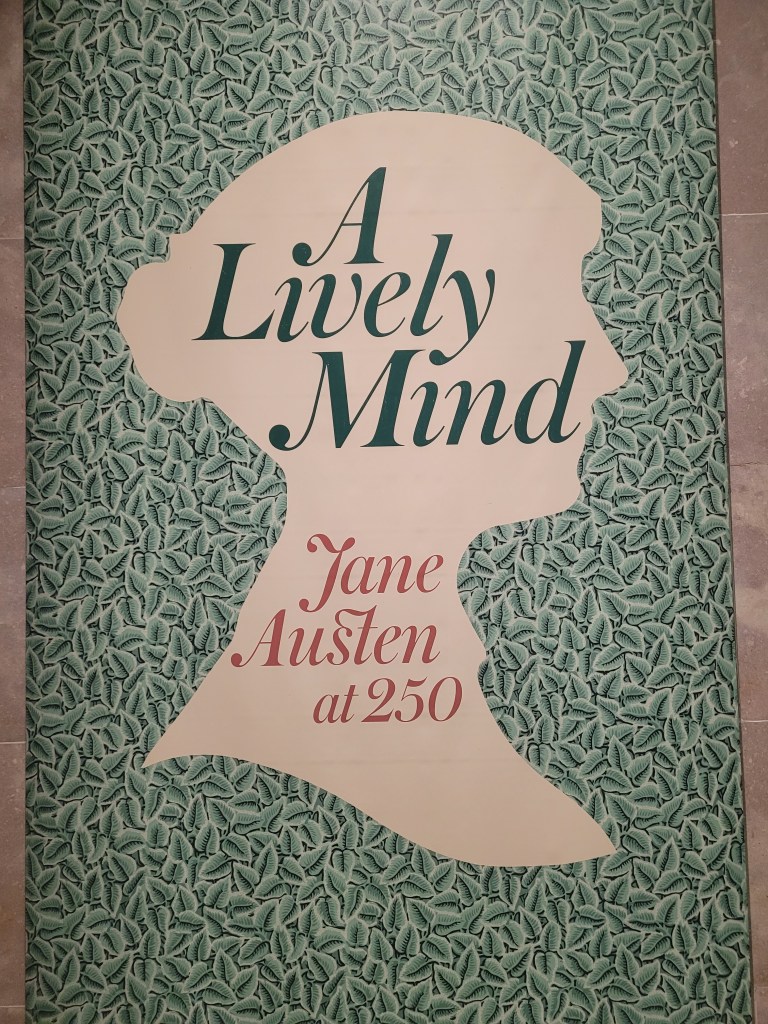
Morgan Library’s Jane Austen show entrance
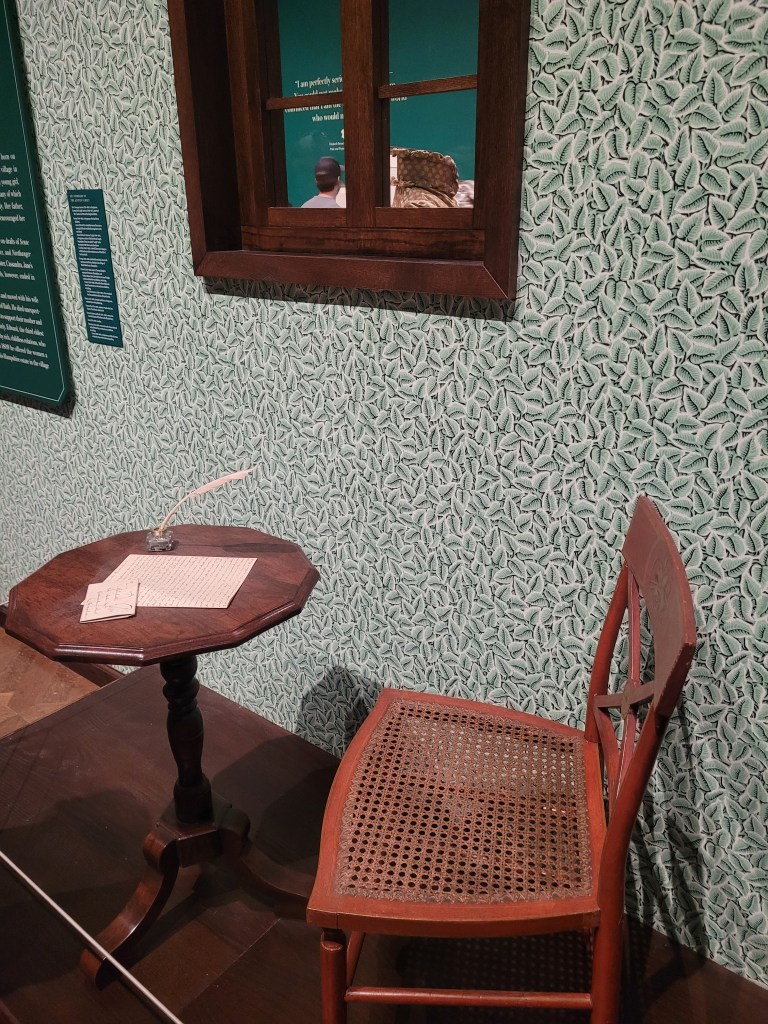
I thoroughly enjoyed my second trip to the library. People of course were talking as they wove their way through the one room installment of the Jane Austen show. However, there was a hushed reverence in the air that felt palpable. It was a wonderful experience seeing Jane Austen’s writing desk and personal letters. One item that made me smile was seeing the Austen family book of poetry. It contained poetry written by generations in the family. On the top of the page opened in the case was the line, “The Poetry of my ancestors I see collected here. How I wish my ancestors’ writing was more clear. Oxford 11/7/1886.” I learned many new facts about Austen I did not know before the visit like her love of music.
Jane Austen’s desk
There was of course emphasis on her close relationship with her sister, Cassandra. My husband said that reading Cassandra’s letter after Jane’s death was heartbreaking. My friend commented that she couldn’t imagine having to wait weeks for a letter to arrive to communicate with her sister, as Jane and Cassandra had to do at times of separation during their lives.
The trip was a very special Jane Austen experience. I especially loved seeing her writing desk and imagining her working on her book at that table. The trip made me think about her books again and why I love and appreciate them. I look forward to when I can share Jane Austen’s works with my kids, especially my daughter. For now I share Jane Austen picture books with them and one special Jane Austen novella I own.
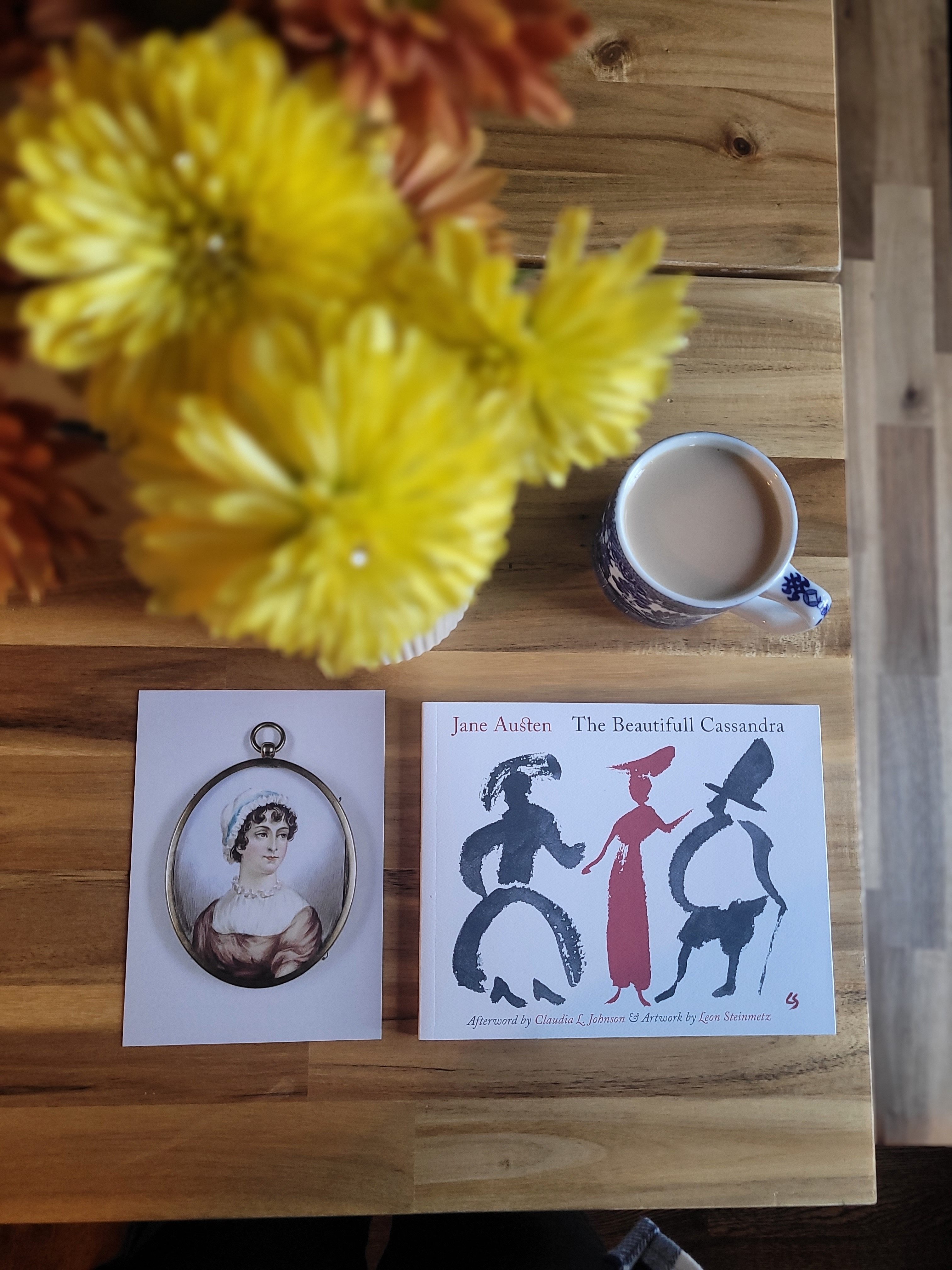
Did you know that as a teenager Jane Austen wrote a novella about a silly and naughty girl named after her older sister, Cassandra? I didn’t either until a friend sent it to me one birthday. It was especially fun to read because as my friend knew, my daughter has a literary/Jane Austen inspired name. The copy I have of The Beautifull Cassandra is illustrated with ink paintings. The simple silhouettes still convey the ridiculousness of the story and the characters’ behavior. It was also fun to have a Jane Austen book I could share with my daughter.
That actually wasn’t my daughter’s first introduction to Jane Austen. When she was a baby, this same friend sent Little Miss Austen: Pride and Prejudice by Jennifer Adams and illustrated by Alison Oliver. It was a counting board book that we read over and over when she was tiny. There is actually a series of these Jane Austen board books. They are perfect for the littlest Austen fans.
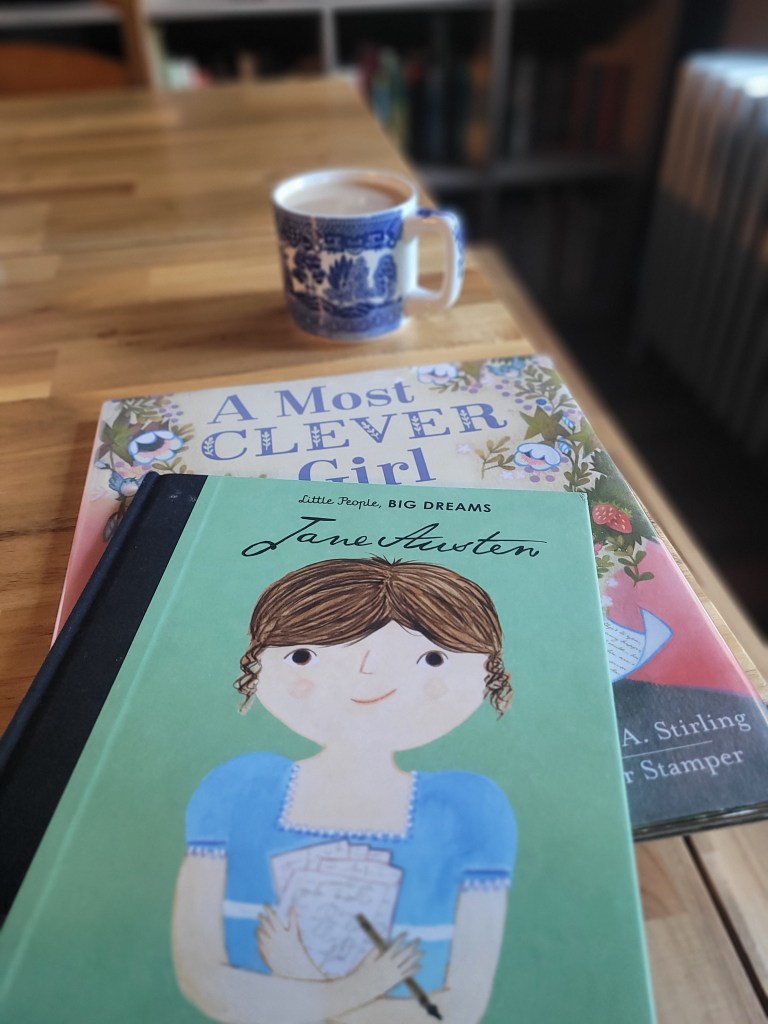
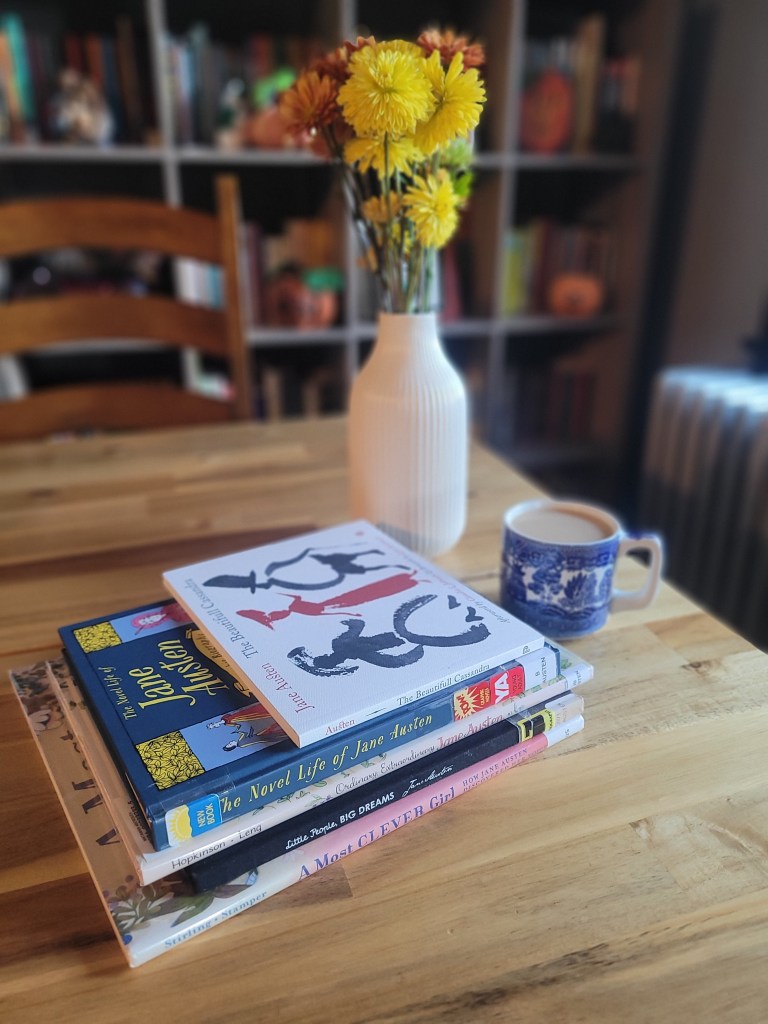
Since my kids are too young to really read or appreciate Jane Austen’s wonderful novels, I read them books about the author herself. We had a family deep dive into Jane Austen over the winter. The first book we read was Jane: My First Jane Austen by Sanchez Vegara Isabe. This book focuses on how Jane had an unusual life and education for a woman at that time and tells a simplified version of Jane’s story which is perfect for young ones. My daughter definitely appreciated learning that Jane was the youngest in her family and that Jane had older brothers, just like she does.
I feel it’s important to teach my kids, especially my daughter, about women from history like Jane Austen – women who stood out and did something different and started paving the way for the modern day woman. My daughter was indignant and shocked to learn that Austen’s first published books did not have her name listed, but instead only said “By a Lady.” They were so surprised that this was normal back then.
My youngest two enjoyed A Most Clever Girl: How Jane Austen Discovered Her Voice by Jasmine A. Stirling and illustrated by Vesper Stamper. This book introduces literary trends during Jane Austen’s life and how she found those styles of books ridiculous. They were overly dramatic, sappy or filled with fainting women. My kids found this amusing. This book shows Jane’s sadness at the death of her father, and it focuses on her journey to find her written voice. It also shared how she had a gap in her writing, likely due to her grieving and moving. I love how the end of this book talks about Jane deciding to write again after so much sadness and how that sadness brought wisdom to her writing. It gives a message of resilience and hope and shows in a subtle way how her writing had also matured through life experience. As readers we don’t always think about how an author’s life shapes their writing and I appreciated how this book made me think and consider those things.
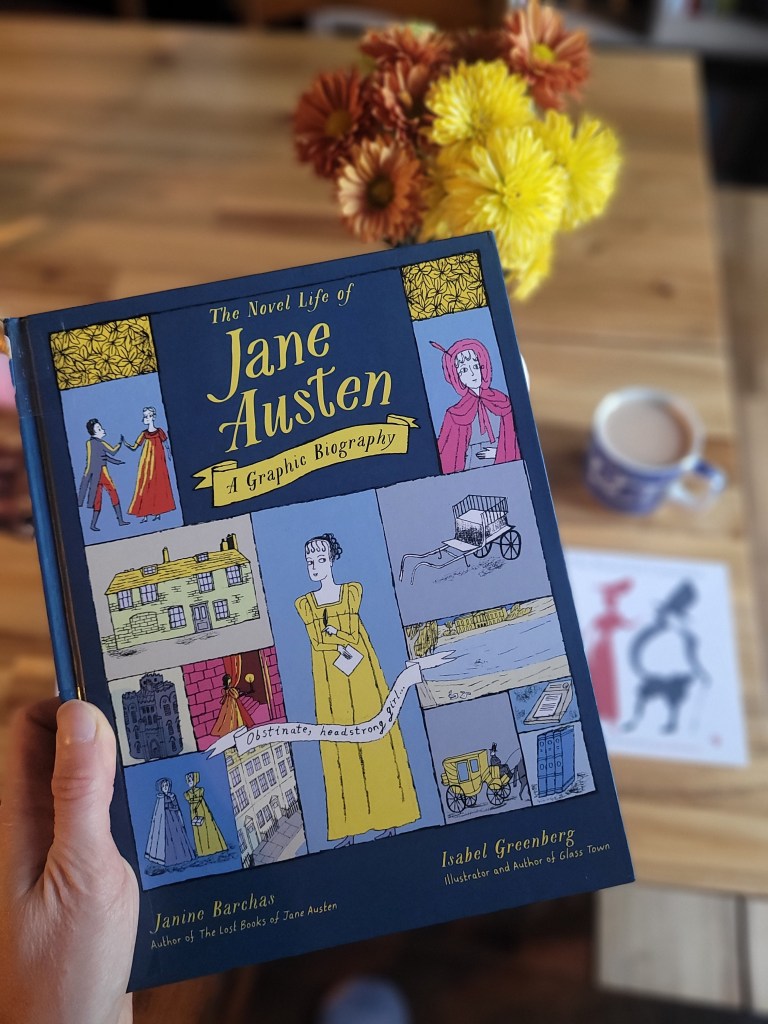
Another book that made me consider more about Jane’s life was The Novel Life of Jane Austen: A Graphic Biography written by Janine Barchas and illustrated by Isabel Greenberg. My kids read graphic novels all the time. They didn’t try to read this one. I did try to get them interested, but they preferred having me read the Austen picture book biographies to them instead. I don’t usually read graphic novels, however, I saw an article about how it was newly published, and I thought it might be a fun way to get biographical information on Jane Austen. This graphic novel is broken into sections or rather different time periods of her life. It was a more detailed telling of her life than what we read in the picture books. I found it interesting how the book shared little side facts about the time period. For example, it was a common practice to rent piano fortes and a volcano erupted towards the end of Jane’s life that affected the weather for the rest of her years. The graphic novel was a fun way to learn Austen’s biography.
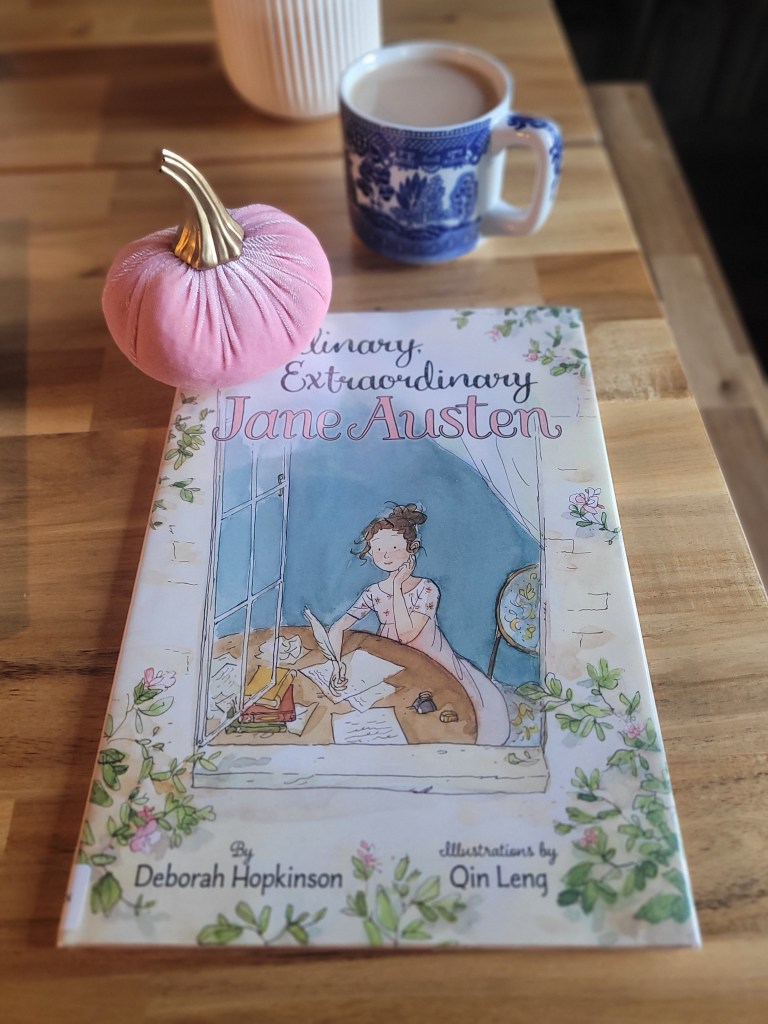
Our very favorite Jane Austen picture book biography was Ordinary, Extraordinary: Jane Austen by Deborah Hopkinson and illustrated by Qin Leng. We loved the illustrations! (Qin Leng is the same artist who did the pictures inA Day for Sand Castles, written about in one of my August 2025 blogs). This book begins with a stronger focus on Jane Austen’s relationship with her father and how he shared his library with Jane and her siblings.
In this book we learned that Austen started to scribble her observations in the margins of books she read. I love the illustration of young Jane in a window seat on the stairway with books strewn all about her in piles. We learned that she wanted her writing to reflect real life. She wrote about the ordinary world in a most extraordinary way. There is a timeline at the end of the book with a list of her novels including blurbs and famous quotes. My younger son really liked going through this part and asked me to read all the blurbs and quotes out loud. Afterwards he asked if there was a movie about Northanger Abbey that he could watch. It was a cute moment and fun to share Austen’s stories with my kids.
I enjoyed my personal deep dive into Jane Austen this past year, but I also absolutely loved sharing my love of Jane and her novels with my kids and friends. It was especially fun to read and watch videos about how the world was celebrating Jane this past year. Lego even made a special Jane Austen Lego set in honor of her birthday anniversary. There were special museum exhibits, parties, books published and even reenactment parties. I wonder what young Jane Austen would think to see people all over the world celebrating her birthday. Happy birthday, Miss Austen!