Ninja Tales and the Imagination

November 7, 2021 By Maria

One of my ninjas

A shadow sweeps silently down the hall. Tiny, quiet feet tiptoe down the stairs; their presence is only revealed by the second to last step’s distinctive creak. The ninja waits, but after a few seconds of stillness, he restarts his quest. The silent warrior continues on his way to the kitchen. A small gloved hand reaches up towards the plate of cookies, thoroughly undetected by the nearby tea-drinking and book-reading mom. Undetected, that is, until the triumphant giggle. This ninja needs more practice! It’s so hard not to giggle and maybe drool a bit when a stolen cookie is within grasp, right? Finally, the ninja attempts to escape with a screeching laugh but is caught in a hug and a tickle. 

My kids love ninja stories. What kid doesn’t? My kids’ ninja obsession led to this post. They read ninja stories, dress up as ninjas, play with ninja legos, make ninja cookies, draw ninjas, and beg me to wear my ninja leggings or t-shirt. They even watch ninja shows and movies. 

I even wore my leggings while editing this piece

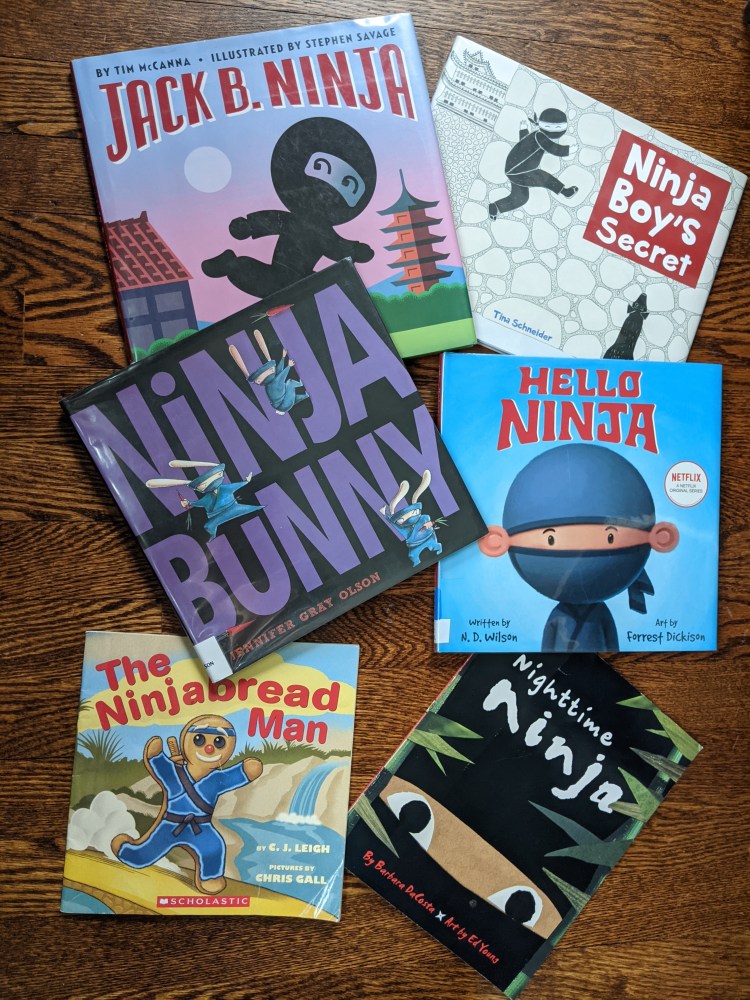
 Hello Ninja, my kid’s favorite ninja show, is based on a picture book, which we read after picking it up through an interlibrary loan. Everyone thoroughly enjoyed the book, so I collected our other favorite ninja books from the library and our shelves and started on this post. N.D. Wilson’s picture book, Hello Ninja, tells the sweet, rhyming story of a little boy dressing up as a ninja and going on fantastic ninja adventures through his imaginations. The book is reminiscent of Calvin and Hobbes, mainly because the boy goes on imaginary adventures with his striped toy cat. (Clues in the illustration lead me to believe it’s a toy, but my kids have hotly debated this a few times already). Forrest Dickison’s playful illustrations give lots of laughs when reading this book. My older son’s favorite part is when the little ninja surprise attacks the mailman, who ends up being, “A messenger who knows kung fu.” I love the childlike imagination displayed through the illustrations, which leads to more discoveries on every re-read. One of the last illustrations shows the inspiration of many of the adventures – a toy dragon, mountain blocks, and childish drawings pinned on the wall. My daughter and I noticed that the landscape outside the boy’s treehouse changes from a suburban town view to a misty mountain view when he climbs back down in his ninja suit. While writing this, I found that Wilson and Dickison teamed up on another book called Hello Ninja Hello Georgie last year. We look forward to reading it once it comes in at the library. 

Ninja Bunny,  by Jennifer Gray Olson, persists as one of our habitual library loans. This book shares a hilariously cute list of rules for ninjas. The readers follow a small ninja bunny, determined to learn the ways of the ninja, entirely on his own and without help. This leads to delightfully funny mishaps throughout the illustrations. Rule number four is very relatable because the little bunny’s ears and feet stick out when he tries to hide. It’s just like playing hide and seek with my four-year-old. In the end, the ninja bunny learns that the number one rule of being a super awesome ninja is friendship. There is actually a second Ninja Bunny book, which I just picked up from the library! My kids enjoyed Ninja Bunny Sister Vs. Brother. My daughter felt sympathetic for the little sister bunny tagging along with her big brother bunny. Besides getting to write about picture books, discovering new books while writing and researching remains one of my favorite things about this blog
Our Ninja picture book favorites

If I had to pick my kids’ overall favorite ninja book from this list, Jack B. Ninja would probably hold that title. My five-year-old loves Jack B. Ninja by Tim McCanna. This book is a clever play on the classic nursery rhyme, Jack Be Nimble. Stephen Savage’s simple illustrations work well with the rhyming text of this book. We follow Jack B. Ninja as he completes a ninja mission and test. The young ninja faces perils, dangers, and opportunities to demonstrate his impressive young skills. However, my son’s favorite part remains when Jack’s mother reveals a special surprise at the end of the book. And don’t worry, Jack does eventually jump over the candle. A ninja story based on a nursery rhyme creates an intriguing twist and fits into the realm of fractured fairy tales. I appreciate fractured fairy tales because they challenge my expectations about classic storylines. 

Another book on my ninja list also plays on a childhood classic, this time, it’s the tale of the gingerbread man. The Ninjabread Man, written by C.J. Leigh and illustrated by Chris Gall, stands out as another of my five-year-old’s favorites. A sifu at a hidden dojo concocts the ninjabread man, who accidentally escapes the oven and confronts the various animal students of the dojo engaged in training throughout the school grounds. The little panda like Sifu reminds me of Sifu in Kung Fu Panda (Another of our favorite movies, of course). Ninjabread man challenges and defeats each of Sifu’s pupils without losing a nibble until he challenges Ninja Fox . . . I’m sure you can picture the, ahem, crunchy end. This book inspired our purchase of ninja cookie cutters. We made our own ninjabread cookies and ninja sugar cookies. The kids love decorating their ninja cookies and, of course, gobbling them up too. 

Like the cookie stealing ninja at the beginning of my post, I, as the mother of wannabe ninjas, definitely relate to the book Nighttime Ninja. Barbara DaCosta’s text starts off as a mysterious journey and ends with a mom stopping the nighttime mischief. The interesting textures of the cutouts and collage make Ed Young’s artwork perfect for this book. In a note at the back of the books, DaCosta writes that she was a bold nighttime ninja herself as a child, always sneaking out of bed to find cookies and the like. Any child who enjoys trying to outfox their parents will enjoy this book, as will any parent who flawlessly and regularly catches their own nighttime ninjas. 

Continuing on the theme of parents and ninjas, Ninja Boy’s Secret by Tina Schneider stands out from the other books because it tells a very different ninja story. Published by Tuttle Publishing company, this book is part of their unique and extensive collection of Asian books. (I hope to research that company and their books after this piece). Tina Schneider intricately weaves her handwritten text right into her illustrations. It reminds me of how an art teacher once told me to find ways to mesh my signature into my artwork. Schneider tells the story of a ninja boy who does not want to do all the things a ninja must do, like climbing walls with ease and becoming invisible. Instead, Ninja Boy wants to play music. After failing his ninja school exam, he overcomes his fear of being different and shares the truth with his father. Ninja Boy wins his father’s heart with a beautiful violin performance. Full of musical information, Ninja Boy’s Secret even has musical definitions artfully covering its endpapers. Whether you are musically inclined or not, this book speaks well to any audience. It eloquently communicates the importance of being true to yourself even when it differs from the norm.

Another one of my ninjas

Being yourself and exploring your imagination remain important goals for us. The goal is still important even when that means that the five-year-old might be dressed as a ninja all day. The ninja obsession among the tiny people in our household truly factored into this post. My kids were delighted when I pulled out a stack of ninja stories to read before and while writing. My tiny ninjas definitely love to hop, chop, and belly flop, and they most definitely “scamper here and there”(Wilson, Hello Ninja). Sending nighttime ninjas back to bed remains a regular and sometimes exasperating venture. Still, I am sure my husband and I will be a little sad when those days end. So, enjoy your own nighttime ninjas and keep reading!
Snailish Summer Reads

July 23, 2021 By Maria

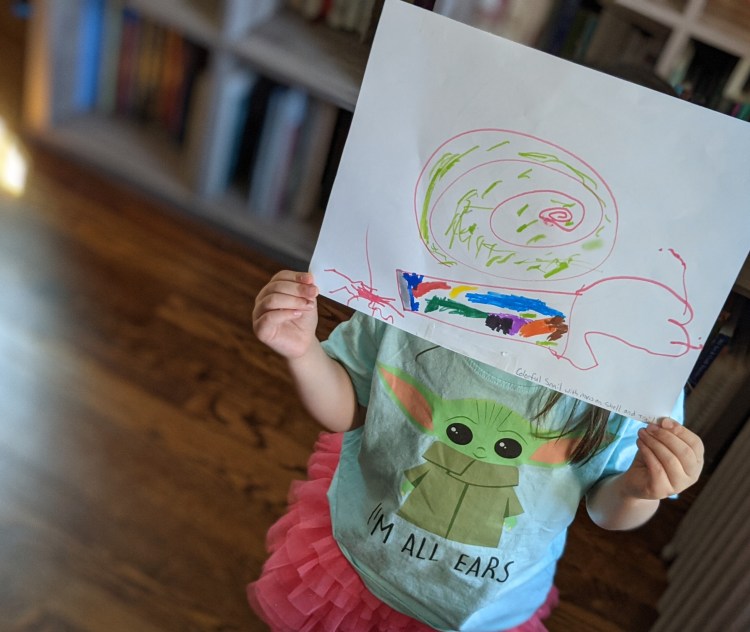
The colorful snail with a “shimmery trail”

Are you feeling sluggish, or should I say snailish, in the summer heat? I, for one, have been feeling the lethargy of heat and humidity and the slower, more open schedule of the summer. What I really want to do is bury myself in a book and curl up, preferably in a place that isn’t too warm or too frigidly air-conditioned. My eight-year-old has been living my dream this week. The kid has read through six or more books since the weekend. Hopefully, our bookshelves and library orders can keep up with his voracious reading appetite. Back to the sluggishness or rather snailishness. . .it is the feeling that inspired this post. Yes, I am writing all about snail picture books, and I will start with our favorite one.

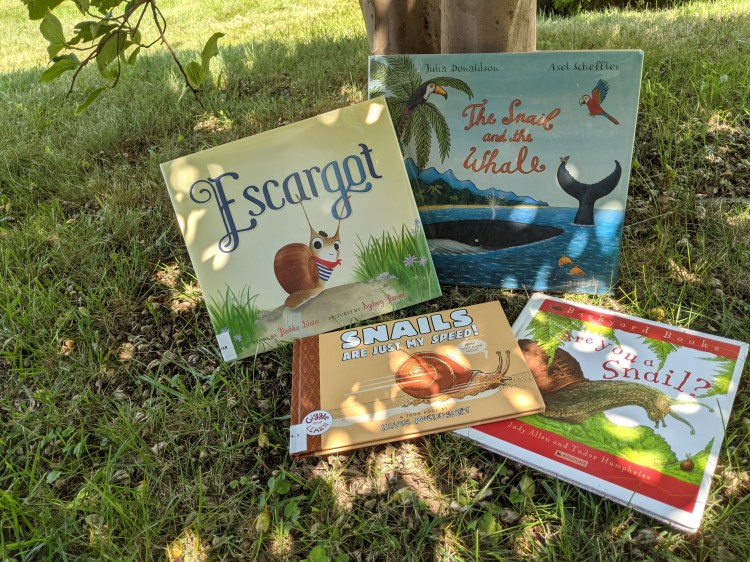
We discovered our favorite snail storybook when browsing the library shelves one day. It is called Escargot, written by Dashka Slater and illustrated by Sydney Hanson. When I pulled up the Amazon link for Escargot, I discovered there is a second Escargot book! It’s already on our library hold list. My kids really enjoy interactive books, and they love Escargot! Escargot, the French snail, talks and interacts with the reader in a short story about confidence, self-worth, and trying new foods. My kids love to munch on carrots now. . .maybe it’s related? This book is entertaining to read out loud. (I attempt a French accent when reading it to my kids, which pulls them into the experience even more and gives my husband a laugh if he is in the room. My small percentage of French ancestry does come out in other ways, too, not just silliness.) My daughter recently drew a colorful snail and included his “shimmery trail,” which is “not slime,” as Escargot says. The book displays colorful illustrations and the cutest little large-eyed and well-dressed snail.

Next on my list is The Snail and the Whale by the famed Julia Donaldson and illustrated by Axel Scheffler, the illustrator of some of Donaldson’s most famous books including The Gruffalo. As usual Donaldson’s rhymes remain enchanting! This story lets those still stuck at home this summer travel about the world on the tail of a whale. In this book an adventurous young snail with an “itchy foot” sails the seas with her whale friend. When the whale runs into dangerous trouble, the small snail saves the day. The little snail not only goes on an adventure of her own but also inspires her snail community to seek more out of life than staying put on a rock, “black as soot.” We enjoyed visiting beaches and coral reefs from our couch with the snail and the whale. This might be a work of fiction, yet readers learn a bit about marine life rescue while enjoying the rhymes and illustrations. 

Taking our snail tales outside!

My last couple snail tales are non-fiction picture books. If you enjoy graphic novels and word bubbles, Snails Are Just My Speed! by Kevin McCloskey will be just your speed. This fun and engaging non-fiction text about snails performs well as a read-aloud and is a Toon Book that works perfectly for younger readers improving their proficiency. It contains lots of pictures and funny illustrations which give a laugh with the lesson. I actually learned a lot about snails by reading this book with my kids. In addition to learning through silliness, we love the Backyard Books series. We have read, enjoyed, and learned with most of the books in this series, though a few have still escaped us. Are You a Snail? written by Judy Allen and illustrated by Tudor Humphries, conveys just the right blend of information and engagement, and as usual, the illustrations of Tudor Humphries do not disappoint. This book contains additional information at the end, which adds to the reading experience. The extra facts are great for an older child who wants to learn more, but they can also be skipped when reading to a younger child if need be. Sharing and learning together can still be enjoyable. The interesting illustrations throughout the book offer opportunities for discussion, reasoning, and the beginnings of scientific questioning.  

Hopefully, everyone finds something interesting in this shimmery trail of shimmery, non-slimy snail books. Or, as Escargot wishes, maybe you will find a new favorite animal of your own, “perhaps the snail”? After reading these books, my kids noticed dried-up trails from snails, or maybe slugs, on the sidewalk around our house. We haven’t found any actual snails in our yards yet, but we did uncover a few slugs. It has been fun taking the learning experience from our books to the outdoors. These books work well together for a short study on snails. You can just add in your choices from craftsexperiments, coloring pages, worksheets, maybe charts like this snail anatomy one, and some outdoor nature studies. While writing this post, I also found this excellent snail lesson put together by Dawn Gunn on the BetterLesson website. In your own snail studies, maybe you’ll even take it as far as the parents of the sweet little snail in #7 from this Bored Panda article. You don’t have to force it; the learning will happen with fun and engagement. So, feeling snailish or not, keep making your shimmery trail of picture book reads this summer!

Why Picture Books?

May 19, 2012 By Maria

I love picture books. I have many fond childhood memories that revolve around picture books and being read to by my parents. Those stories became a huge part of my imaginative canvas as a child and I see the same thing happening in my kids. Picture books are such a great source of storytelling, art and information, including nonfiction picture books.  As I grew older, I continued to check picture books out of the library as a teen and even as a college student. Susan, one of the librarians, started to recognize my interlibrary holds by the books I would select. I loved, and still do, feasting my eyes on the artwork and visual storytelling. Of course I continue to read and borrow picture books from the library, but now I read them to my kids. Sometimes, I do sit down after my kids are in bed for the night and pour over a stack of picture books. . . especially those new ones from the library. Through careful searching and checking library sales, I have slowly but surely curated a still growing and changing home library of children’s literature and picture books that my kids enjoy. We also always borrow a large stack of books from the library. Yes, I am that person. You know, the one who holds up the line at the circulation desk slowly feeding an enormous amount of books through the new covid safety plastic partition. I’m still not sure if the librarians are happy or annoyed when I approach the desk with my towering pile of books. They usually smile so I take that as a good sign.

Maybe you’re wondering why invest so much time, and library runs, into picture books? The simple answer is the artwork. Picture book artwork varies from exquisitely detailed and beautifully rendered to delightfully humorous and thoughtfully simple. Think about it, picture books prevail as children’s most frequent exposure to art. The artwork in those books is very important. Look at the detail and visual storytelling in Jan Brett’s illustrations and the extensive amount of work put into producing a graphic novel like Ben Hatke’s Little Robot which relies heavily on art to tell the story. A picture book relies on the artwork; the illustrations share the little details and emotions the text leaves out. My kids very quickly pick up on these small details and laugh with delight at the humor an illustrator indicates or form their own understandings and observations by looking at the pictures. Children, and adults, learn empathy through reading. For my kids the illustrations really help with that. Also children, especially younger children, have an easier time following stories if there are pictures to look at too. Sometimes they struggle when only listening with their ears because they do not have the same range of mental imagery that an older child or an adult may have. In a podcast interview from Sarah Mackenzie’s Read Aloud Revival site, I learned that in MRI studies the brains of children listening to a story with pictures operate optimally versus when just listening to a story with ears alone or watching an animation. See, I’m onto something, picture books are important and an illustrator’s work should not be dismissed. 

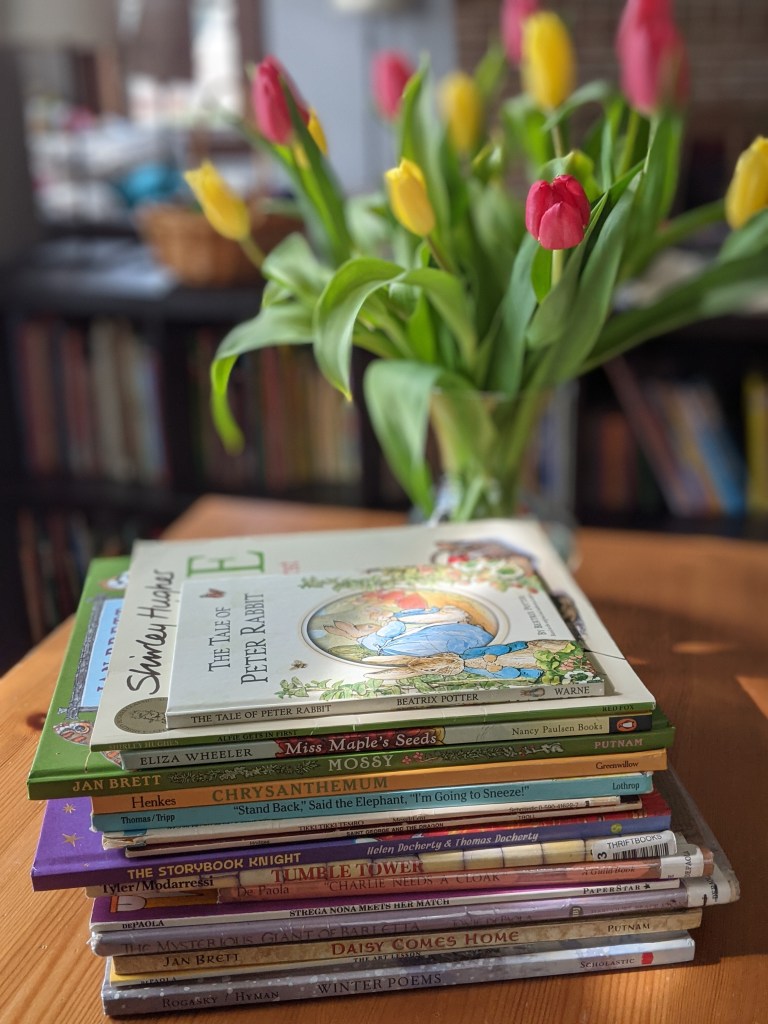
Since this post is about the importance of picture books and my personal warmth towards them, I decided to share a favorite picture book and author with you. I went to the bookshelf and attempted to collect a few favorite picture books to choose from and realized my stack was becoming heavy and contained close to twenty books. . .and I still wanted to add more! With hard decision making, I narrowed it down to one. 

A book I have enjoyed since childhood is The Tale of Peter Rabbit by Beatrix Potter. I chose Beatrix Potter even though I am sure almost every reader here has already come across her charming, but naughty, vegetable stealing rabbits. Her books may feel a bit archaic in this day and age, but they are universally understood by children.  Learning as an adult about Beatrix Potter’s life and how she wanted her books to be small so that children could easily hold them and the pricing to be low so that families could afford them, makes her and her delightfully tiny books even more dear. Beatrix Potter’s illustrations are beautiful! Her animals may be dressed in waistcoats and frocks, but they are real animals. When we read Peter Rabbit my daughter expresses concern about Peter being caught by Mr. McGregor and my son listens with wide eyes. Even though they know the story very well, they love traveling through the pages together and telling me that Peter is “not being a good listener.” Once during a silent point at church, my oldest who was around two years old at the time and very into Peter Rabbit, loudly yelled Mr. McGregor’s line, “STOP THIEF!” It was simultaneously hilarious and utterly embarrassing. I still think of that moment every time we read that part of the story. We have been adventuring through Beatrix Potter’s books for some time and there are still a few even I haven’t read yet. If you already know the popular characters, try one of her lesser known stories and enjoy! Beatrix Potter remains a personal favorite and an inspirational woman in the field of children’s literature and botanical art. 

Hopefully, you have been inspired to add some picture books to your library load this week. Don’t be afraid to show up at the library with two tote bags. . .or maybe even a crate. Try starting with a favorite author or illustrator and check out some of their books you haven’t read yet or search for a few Beatrix Potter books. Explore the picture book section. The significance of picture books remains the most important thing I hope you take away from this post. Picture books, besides great sources of literature and fun, are also great learning resources. My kids and I enjoy reading and learning together from picture book stories and biographies, science books and more. I look forward to delving deeper and sharing other favorites at a later time. Happy Reading! 

References:

Snow

March 14, 2021 By Maria

Snow. Something everyone loves or at least appreciates the beauty of even with the inconvenience it brings and the back breaking shoveling it can involve. Who loves snow most? Well, kids of course! And who loves reading about snow? Everyone. . . or at least I hope. Personally, I find stories set in cold and snowy settings give me a delicious cozy feeling like I’m really curled up in a warm blanket with a hot cup of tea watching snowflakes dance outside the window. When we had our first snow of the season, it was spectacular. . . minus the shoveling. The snow dusted trees were magnificently highlighted and every nook emphasized. The air felt still and peaceful and the white snow covered everything in a uniform beauty.  Without knowledge of the upcoming forecast, I read some snow books to my kids a few days before the snowstorm. I’d like to share some of them here. 

The first is a beautiful book called It’s Snowing! written and illustrated by Olivier Dunrea. The illustrations charmingly tell the story of a mother introducing her baby to snow for the first time. The text is simple and almost rhythmic. Painted in gouache, the pictures show the fur wrapped mother and baby exploring snow on a dark and cold night. They build a snow bear and a snow troll together. (Inspired by the book, my kids tried to build their own snow bear when sledding at my mom’s house.) Years ago I found this book by chance at our local library and I continue to check it out once or twice every winter. (Another of Olivier Dunrea’s books I recommend for beautiful snow paintings is a Christmas story called Bear Noel.)

 My two little ones cannot read on their own yet and they occasionally enjoy books without words like Fox’s Garden by Princesse Camcam from the Stories Without Words series. I am not familiar with the rest of the series, but hope to explore them soon. Even though this book does not contain text my kids usually prefer I tell them the story at least the first time we peruse it. The cut paper illustrated story takes place on a cold snow covered night in which a lone fox searches for a warm place to rest. After meeting rejection at every turn the fox receives a kind gesture from a young boy and in turn leaves him a token of her thanks. This book appears short and plain but the lesson of kindness and sharing can be easily recognized even by small children. I try to discuss the stories we read and ask the kids questions that help them comprehend and reflect on the books. Asking questions while reading is actually a new habit I am trying to form after listening to some virtual lectures over the summer about reading with children.

The third book in my snow book pile is Snowflake Bentley written by Jacqueline Briggs Martin and illustrated by Mary Azarian. This book is a fantastic example of an educational picture book! It shares the life and passion of Wilson Bentley told in story form with charming woodcut illustrations and a side bar containing more biographical information. Wilson Bentley was a farm boy who pursued and observed nature with the eye of a scientist. His persistence after countless failures made him the first person to photograph a snowflake. Wilson Bentley’s book, Snow Crystals, remains the first source of those who wish to study this subject.  I read this book to all my kids, but the seven year old benefited most from it. Though suited better for an older child, Snowflake Bentley introduces younger children to the beauty and wonder of science even if the text needs some paraphrasing.  There are so many snow books I would like to talk about in this post, but to keep it from growing into an enormous snow drift I will stop at three for today.