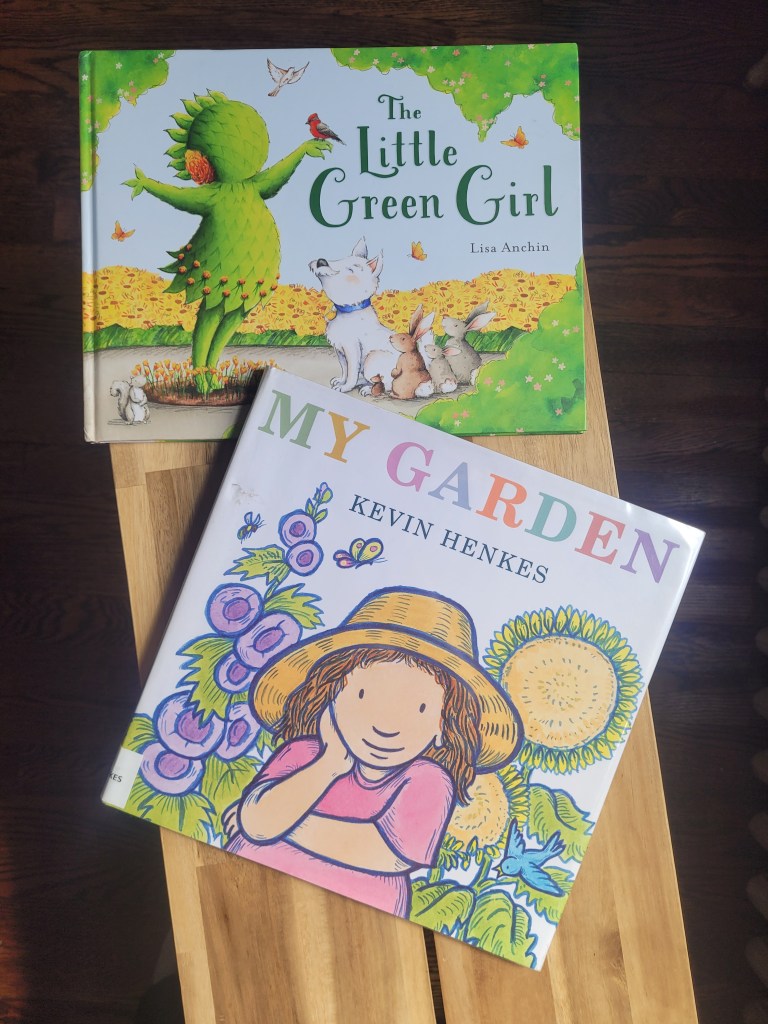
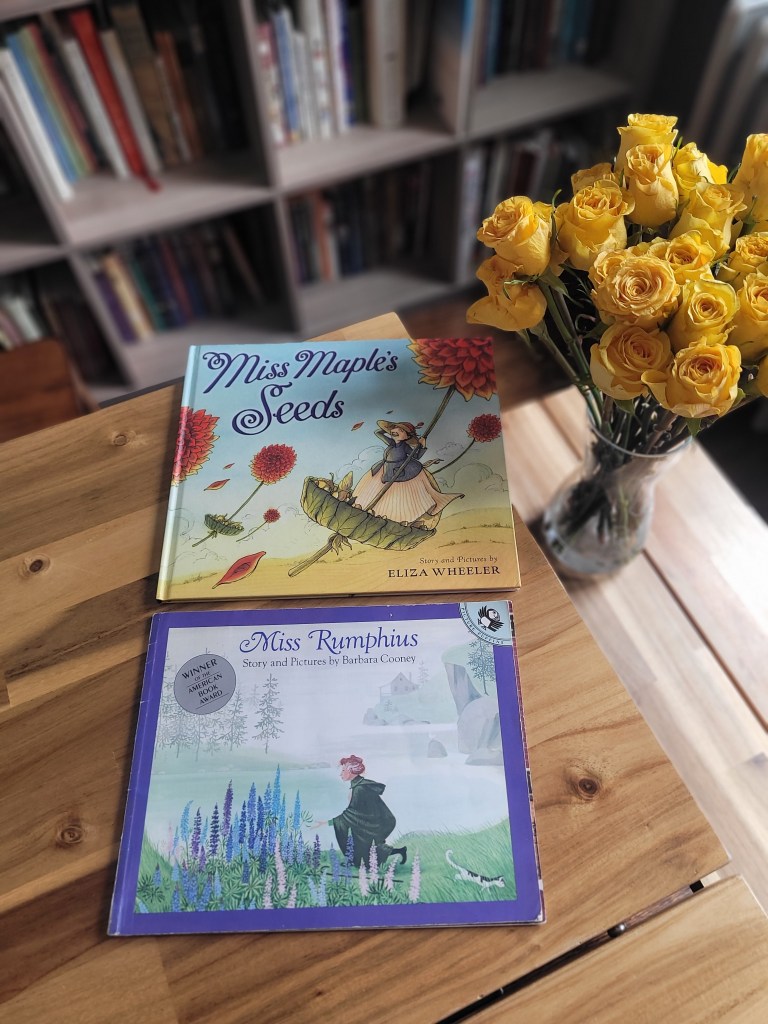
Puddle Walks

April 14, 2025 by Maria

We have been getting so much rain. Let me say that again, so. . . much. . . rain. . . Our absolutely beautiful spring weather from a couple of weeks ago has unfortunately turned into dismal dreary rain and cold chills. Wetness, mud, and puddles wait outside now, and still allergies. (How is the pollen not all washed away?) In my previous spring post, I mentioned how I used to regularly take my kids on “puddle walks.” We’d walk through the neighborhood looking for the best puddles and then they would splash to their hearts’ content. Puddles. What is a puddle to you? Is it an inconvenience, a delight, a nuisance? What is a puddle to the children in your life? 

The last few mornings, my nine-year-old has been fascinated by the giant puddle near his bus stop. He knows he can’t step in it for fear of having wet feet all day at school. Instead, he leans out as far as possible peering into the water and occasionally grabbing a stick to poke around in the puddle. This fascination with puddles is nothing new for this child. He has always hated the accidental spilled drink on his shirt or wet sleeve from washing hands, yet he loves puddles and splashing. 

Since our weather has taken such a wet turn, I decided to give my attention to some wet weather and puddle centered books. April showers bring May flowers as they say. Why not splash into some puddle filled stories while we wait out the rain in the warmer and drier indoors? So, come on a literary puddle walk with me. The first book here is Puddles by Jonathan London and illustrated by G. Brian Karas. This book is about a brother and sister going outside to play the morning after a storm. They find all the beautiful wonders rain leaves behind like glistening water droplets on leaves and of course puddles. They have a blast splashing and playing in puddles despite their mother’s warning to stay dry.

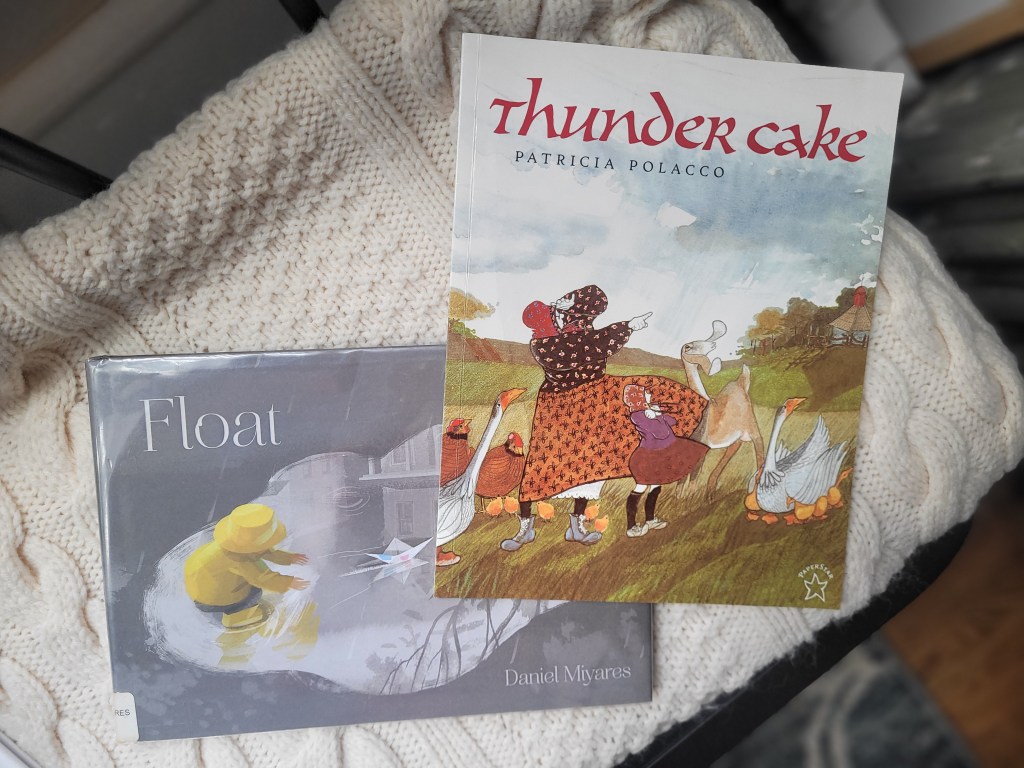
Thunder Cake written and illustrated by Patricia Polacco is a story that focuses more on the storm or the anticipation and fear before a storm starts than the wetness afterwards. Polacco beautifully illustrated this story about a grandmother helping her granddaughter overcome her fear of thunderstorms by having the child help her gather ingredients and prepare a cake that can only be baked during a thunderstorm. This is a beautiful story about fear and bravery and the special bond children have with grandparents. 

Sometimes kids have a bond with a special toy or object like a teddy bear or blanket. Sometimes it has to do with a memory or the person who gave them that item. My daughter once carried a pink paper plane around the house for a week or more after my husband made it with her. The little boy in Float by Daniel Miyares makes a paper boat with his dad and then heads out the door to play, dressed in hat, raincoat and boots. Through this wordless book we see the boy go on many adventures through puddles and rain with his boat until the boat does what all wet paper eventually does; it falls apart. The tearful boy returns home with his ruined boat to find his father waiting with a warm hug and dry clothes. After drying his tears and hair, the boy and his father make something new with another sheet of paper and the boy heads outside again to play and explore. 

Worm Weather by Jean Taft is a fun rhyming book about two kids exploring rain, mud, and wormy spring weather with their mom. Our favorite part is when the boy is about to belly flop into the huge muddy puddle, but the mom grabs him mid air. Matt Hunt’s illustrations make this especially funny. One of the best things about being outside and getting wet in the rain is going inside to get warm and dry. Their mom brings the kids to the perfect place to grab lunch and warm up after all their puddle play. 

Hello, Puddle! written by Anita Sanchez and illustrated by Luisa Uribe is about a large puddle that has formed in a girl’s backyard. She watches the changes in seasons and the various wildlife that visit her backyard puddle over the spring and summer through fall and until winter. This is a great nature study and wet spring story combined. In the end notes, the author shares that the puddle in this book is based on a real one in her own yard. Sanchez writes that she also watches animals visit her puddle. 


I miss puddle walks. I miss watching my kids’ delight at the biggest splash and seeing one or two, or all three sit down on the curb to pour water out of their rain filled boots. A warm bath, fresh clothes and some hot chocolate or tea with a snack were always post-puddle walk requirements. The cozy time after a puddle walk was also a great time for a read aloud. Hint, hint.  

Petals, Puddles and Pages

March 29, 2025 By Maria

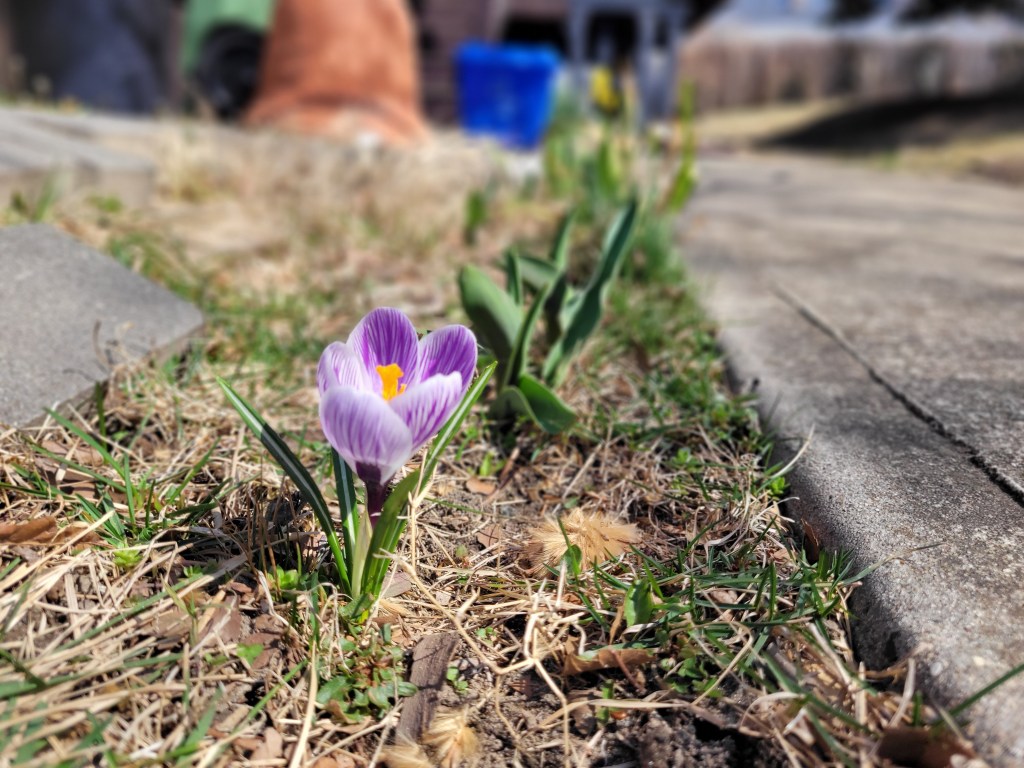
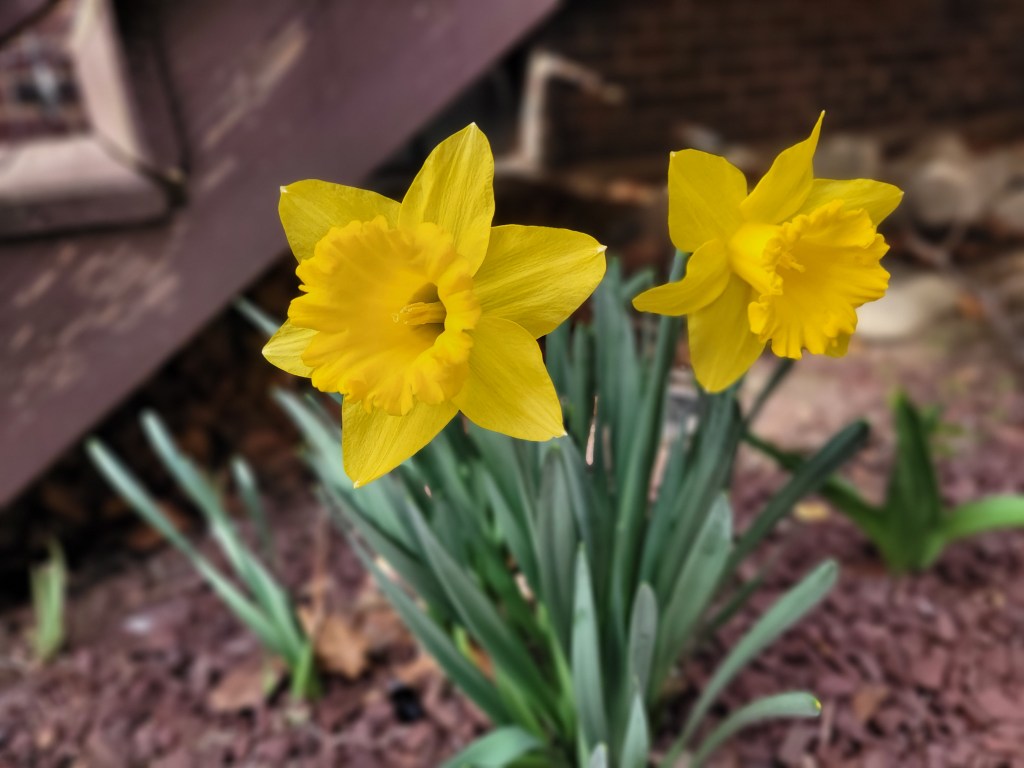
A week or so ago, my younger two kids eagerly told me to come outside to see something amazing. I slipped on shoes and stepped out the door to see them excitedly pointing out a flowering crocus they had found. “The first flower, Mommy!” Spring’s here!” They exclaimed.

Every year when crocuses start to peek through the leftover snow or brown grass, I get a rejuvenated feeling. Winter is ending! Warmer weather and more sunshine are on their way. I do enjoy winter and snow and am a bit sad to see them go. Still, spring puts a little energy into my step and walking in warm spring weather with a light breeze is exuberant, at least until the allergies start. Flowers and less scarves and hats are in the forecast. . .plus lots of rain. Rainy spring days are great for a couple of my favorite things, tea and a stack of books. 

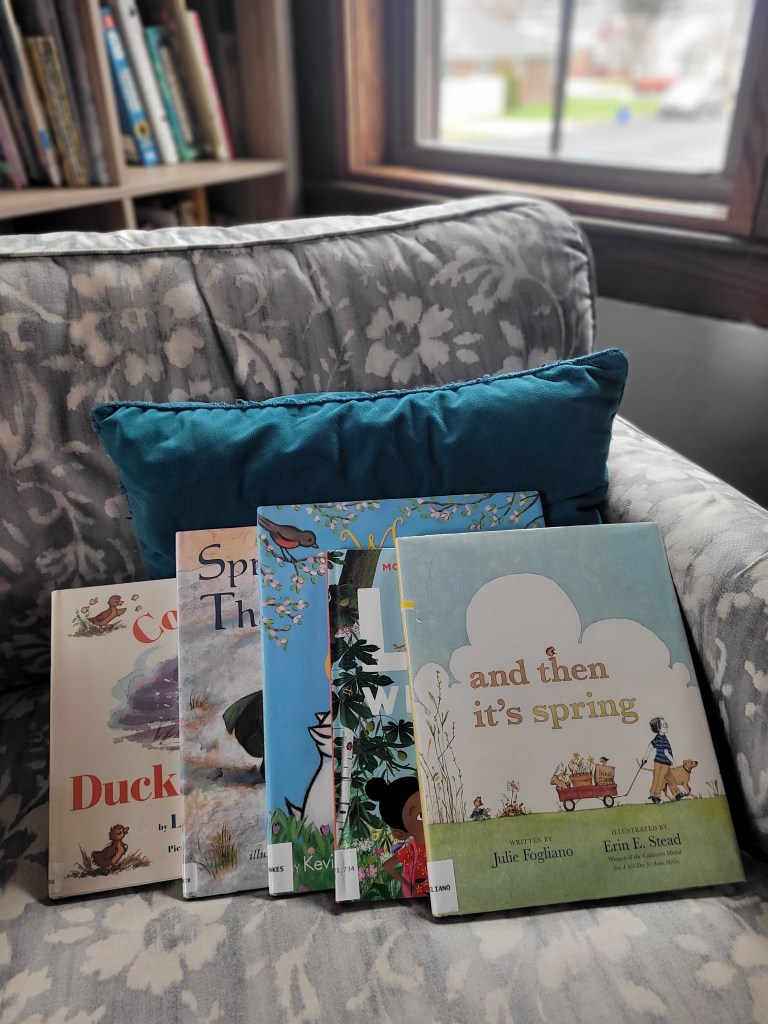
When spring comes around, I always pull a few of the same seasonal books off the shelf at the library. The first couple books are perfect for the glimmer of very early spring. Stacey Schuett’s beautiful illustrations of snow scenes glitter with happy colors in Spring Thaw by Steven Schnur. This story follows the spring thaw from its arrival at night to the first crocus appearing in the final illustration. This story takes the reader on a peaceful journey noticing the little seasonal changes in what appears to be a New England farm.

 Cold Little Duck, Duck, Duck by Lisa Westberg Peters also brings a hope of spring to cold days. Illustrated by Sam Williams, this book rhythmically tells of a duck who returns from migration too early. Her hopeful thoughts of spring and its prompt arrival rescue the cold little duck . She is happily frolicking with her flock by the end of the story. The illustrations are so cute and suited for a young audience.

Another great book for young audiences is When Spring Comes written by Kevin Henkes and illustrated by Laura Dronzek. I always love finding books created by married couples, like this one. I grew up loving Kevin Henkes’ mouse stories and I love sharing them with my kids. It was fun to discover that his wife makes books too. This book takes you through the slow changes of spring to find that when it finally arrives, we will have to wait for summer. The couple has made a book for every season and they are all wonderful. My favorite illustration is of kids in boots and umbrellas playing in puddles with the question, “Do you like mud? Do you like puddles?” My kids always love puddles, and sometimes mud. We used to go on “puddle walks” after a heavy rain. Dressed in raincoats and rubber boots, they wouldn’t wait to go splash in puddles. 

Another book about waiting for spring is And Then It’s Spring by Julie Fogliano. Erin E. Stead’s illustrations of a boy and his dog tending to and patiently waiting for spring and their garden to bloom are so sweet and detailed. There are lots of tiny things to look for and discuss while reading this book. We always enjoy watching the hilarious things the dog tries to plant in the garden. Going outside and planting some seeds is a great way to get kids outside and excited about learning. 

If these books don’t get you outside and looking for spring, try Look What I Found in the Woods. Moira Butterfield’s book follows three kids exploring the woods. The illustrations by Jesus Verona are full of details for kids to find and ideas for your own nature walks. This book is jammed with lots of information and makes it a great book for a nature study unit or botany study.

If you are looking for a scientific explanation of spring, The Reasons for the Seasons by Gail Gibbons is a fantastic and detailed explanation of why we have seasons. This book contains a lot of information and is a longer read, which makes it great for older kids. Gail Gibbons’ science books are fantastic. I love incorporating picture books into science lessons and this is definitely a favorite.

I hope you find some good spring stories here and maybe even a few new favorites. Whether you are stuck in a delayed spring or are ready to charge outdoors, stories can help little ones understand and appreciate the seasonal changes. Returning to these beloved books and illustrations (and discovering new ones) helps me appreciate and not dread the seasonal changes as well. So, get out there! Stamp in some puddles, read some books and smell the flowers!
The Irish Magic of Tomie dePaola

March 18, 2025 By Maria

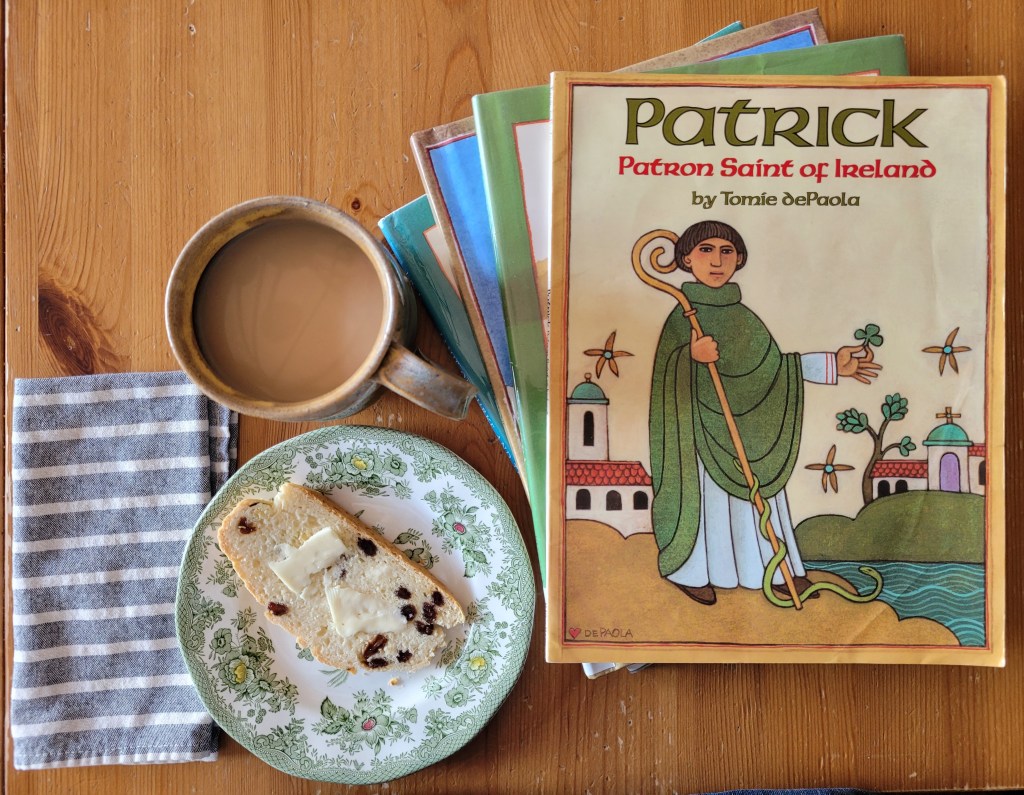
St. Patrick’s day snuck up on me this year. In a busy blur we managed to pick up buttermilk over the weekend and yesterday afternoon, my daughter and I, up to our elbows in flour, kneaded and baked Irish soda bread. We started the day by reading Tomie dePaola’s St. Patrick book. Afterwards my green clad daughter proceeded to cut a small pile of shamrocks from green construction paper while I set up her lessons for the day. The day felt like a green busy blur. 

Growing up, I always enjoyed wearing green on St. Patrick’s Day – especially proud that I was a bit Irish – and eating Irish soda bread. My mom hates to bake, yet she would almost always make it for the day. The easy recipe was given to her by an old Irish lady at our church who was from County Cork, Ireland. 

I never grew up eating corned beef and cabbage. It seemed strange when it was introduced to me as a teenager by friends and I still haven’t come to enjoy it.  Irish soda bread and stories by my favorite Italian/Irish children’s book author/illustrator, Tomie dePaola, are my St. Patrick’s Day traditions. Tomie dePaola grew up in Connecticut, born to Italian and Irish parents. His maternal Irish grandparents introduced him to St. Patrick and the marvelous Irish tales. The St. Patrick’s Day stories my kids and I love to read are all by dePaola. It doesn’t feel like St Patrick’s Day without at least one of his Irish books. 

Of course, the first book to discuss is about the saint himself. Patrick: Patron Saint of Ireland by Tomie dePaola tells Patrick’s story from his childhood kidnapping by Irish pirates to his extensive mission work on the Emerald Island. My kids really enjoy the collection of St. Patrick legends at the end of the book, especially the story of St Patrick banishing the snakes and the story about when he sailed on the altar stone. 

DePaola’s Jamie O’Rourke stories are hilarious. I remember my mom reading me Jamie O’Rourke and the Big Potato as a kid. And I, who was not fond of potatoes as a child, couldn’t imagine eating all that potato for so long. Jamie O’Rourke, the laziest man in Ireland, catches a leprechaun but is tricked into accepting a magic potato seed in place of a pot of gold. Despite the mayhem created by the giant potato, the situation turns in lucky Jamie O’Rourke’s favor.  

Tomie dePaola’s Irish stories and a loaf of County Cork Irish soda bread

Jamie is not quite as lucky in dePaola’s second Jamie O’Rouke story. My kids and I discovered Jamie O’Rourke and the Pooka on the library shelves years ago. It is a fun story that acts as a playful warning against laziness. When one of my kids is especially chore avoidant, one of us will lightheartedly remind them not to turn into a pooka. The kids did find the illustrations of the pooka a bit scary when they were tiny and we first read the book, but they grew to love the story. Hopefully, we learn a lesson from the pooka even if poor Jamie did not. 

The lessons in Fin M’Coul are a bit different. Fin M’Coul: The Giant of Knockmany Hill is a book I read many times while growing up. I always knew where to find it on the library shelf. Since he was small my oldest son has always loved trickster stories (the first non-reader book he read was an Anansi picture book. It was quite long, but he was motivated). The kids all love the tricks Fin and his wife Oonagh play on the evil giant, Cucullin. I also appreciate Fin’s trust in Oonagh and her plan and her decision to face Cucullin. It’s also pretty neat how the Giant’s Causeway is included in the story. We looked up pictures of that incredible rock formation after reading the book. We always love finding a bit of real life in fiction. 

Life isn’t fiction, so I did not get this post out before St. Patrick’s Day. In spite of that, I hope you had fun this St. Patrick’s Day! The week of the 17th isn’t over yet, so eat your Irish soda bread or corned beef and cabbage, if that’s your preference. Brew a cup of Irish breakfast tea and enjoy an Irish story. Wear your green and watch out for those tricky leprechauns attempting to give away potato seeds instead of pots of gold!

Scales and Scones

December 12, 2024 By Maria

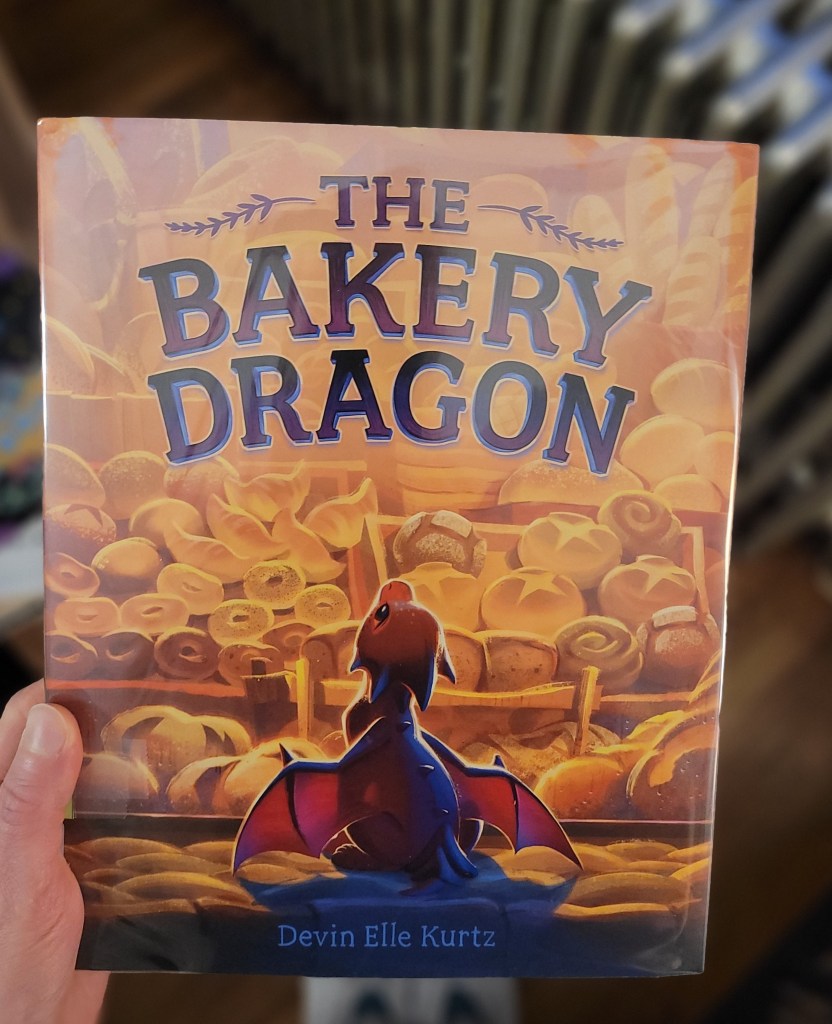
 On my way out of the library, I always check for a new edition of the free Bookpage magazine. This magazine promotes newly published books. I usually flip through it a few times and then write the books that interest me on an ongoing list. I will either look for them in the library immediately or save the new titles for a rainy day. When I saw The Bakery Dragon listed in the children’s book section, I knew it would be a hit with my kids and immediately placed an interlibrary loan hold. 

Disclosure: Some links found here are affiliate links. This means that if you make a purchase using one of these links, I will receive a small compensation with no additional cost to you. Thank you for your support!

The Bakery Dragon is by Devin Elle Kurtz, who started Photoshop painting at the age of two when her mother handed her a tablet pen. She started her career in the animation industry and now illustrates books. This is her first authored and illustrated picture book. Her illustrations give off a cozy feeling and are reminiscent of Studio Ghibli’s work.  

I love how light plays into Kurtz’s illustrations. The cozy glow makes the piles of baked rolls look even more delicious. In the story, a little dragon named Ember, who is terrible at plundering and hoarding gold, accidentally comes upon a bakery. The welcoming baker teaches Ember how to make bread. After assisting the baker, he happily returns to the dragon caves with a hoard of golden rolls. Ember decides to share his scrumptious hoard with his fellow dragons. Their newfound love of bread brings a change in the dragons’ behavior that the villagers joyfully welcome. 

My kids love dragon stories and are currently getting into DnD (Dungeons and Dragons). This story fits their current and ongoing interests. Besides, when are cute dragons and yummy bread not fun to read about? This book makes me want to start baking or go visit a bakery like I used to as a kid with my parents. I remember walking into an Italian bakery with my dad, smelling the mouthwatering bread, and hoping we’d walk out with a focaccia and not just our usual loaves of bread (Sometimes we did get both). As the weather gets colder, it’s the perfect time to throw a loaf of bread or a batch of scones in the oven and curl up with a book while the aroma of baking bread fills the air. Get cozy and get reading!

The Sensitive Search for Joy

October 24, 2024 By Maria

Disclosure: Some links found here are affiliate links. This means that if you make a purchase using one of these links, I will receive a small compensation with no additional cost to you. Thank you for your support!

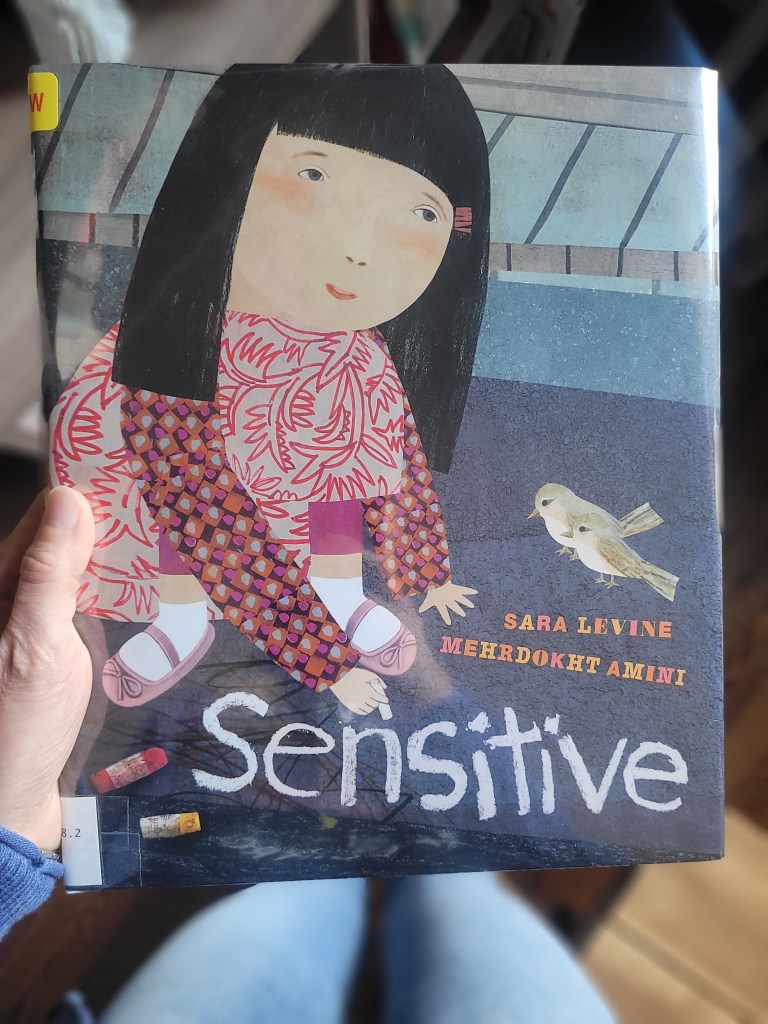
We are almost two months into the school year. It feels like we just started and also like we’ve been doing this forever. Since school began my kids have been tired, a little stressed, and emotions are sometimes high. It always helps to discuss a relatable story in a situation like this. The other week I found a beautiful and tender book on our library’s “new” shelf. It was Sensitive  by Sara Levine. This book is about a little girl sharing her struggles as a sensitive person and the negative impact of hurtful things people say to her. Sara Levine wrote this book because she was often called “too sensitive” as a child. I love how she took a negative childhood experience and shared how she grew and overcame it. 

Thoughtful typography plays a big part in how this story is visually told. The text is interwoven with Mehrdokht Amini’s illustrations and the text even becomes illustrative features on some pages. The typography integrated into the art helps kids understand how our words affect others negatively or positively. My daughter and younger son were very invested in reading all the words and phrases that literally get inside the girl’s head. It was beautiful and encouraging when the girl took all the overwhelming negative words and wrote them out, reordered into a positive message to herself. My daughter, who can be sensitive, immediately asked me to read the book a second time. This is the perfect book to read and discuss with a sensitive child. It’s also a great resource for discussing emotions and mental well-being. The book also has a realistic ending. The girl can’t remove all the words, but she has learned not to be controlled by them.  She has found joy.

Stories and Mooncakes: The Lady in the Moon

October 7, 2024 By Maria

This year’s mooncakes and one of our stories

Here I am continuing my Mid-Autumn Festival short series. As I described in my previous post, the Mid-Autumn Festival is an Asian harvest holiday of family togetherness. The books I write about here center on the myths surrounding the festival. In Chinese Mid-Autumn celebrations, the myth of Chang’e and Hou Yi takes center stage. While staring up at the moon, grandparents and parents often ask children if they can see the lady or rabbit on the moon. My kids love doing this.

As the story goes, once ten suns took turns crossing the sky each day. One day the suns decided to all travel together across the heavens. The earth burned and the people called out in fright and supplication. An archer, Hou Yi, took his bow and shot down nine of the ten suns, saving Earth. The celestial beings blessed Hou Yi with a gift, the elixir of immortality, which he and his wife, Chang’e hid in their home. When Chang’e was alone in the house, an evil man broke in and tried to steal the elixir. Chang’e drank the entire flask to stop him; after which she floated up to the moon as an immortal being. She would stay forever on the moon in the company of the Jade Rabbit (whose story is for another time). Hou Yi was devastated at his wife’s disappearance but noticed her familiar shadow on the moon’s landscape. After that, every year on the anniversary of her departure, Hou Yi would sit at an outdoor picnic with Chang’e’s favorite round cakes (mooncakes) and gaze up at the moon while Chang’e lovingly shined the moon’s bright light down on Hou Yi.

The first book contains a beautiful version of Chang’e and Hou Yi’s tragic love story. It is written by Christina Matula, a Canadian-born Taiwanese and Hungarian author. It is illustrated by Pearl Law, a Hong Kong illustrator who works in multiple art genres. Christina Matula has also written a second Mid-Autumn Festival book; it is about a girl of multicultural background finding her unique way to celebrate the Mid-Autumn Festival. The Shadow in the Moon: A Tale of the Mid-Autumn Festival by Christina Matula remains our favorite retelling of the tale of Chang’e, the Lady in the Moon, and her beloved husband, Hou Yi. At a family’s moonlit banquet the grandmother, Ah-ma, tells their story to her two granddaughters. The story inspires one of the granddaughters to wish on the moon for wisdom and kindness. I liked how this book focused on the family coming together and a young girl being inspired to do good and seek self-improvement. There is also a mooncake recipe at the end of this beautiful story.

Beautifully illustrated by Renné Benoit and written by Loretta Seto, Mooncakes occurs during a family’s moonlit picnic. This book artfully mixes fairytales with family togetherness. The young girl in the story shares mooncakes and tea with her mother and father as they tell her various legends about the moon. I like how this book shares more than just the story of Chang’e; it also covers the stories of Jade Rabbit and Wu-Gang. One difference that the kids and I noticed is that in this version of the myth Chang’e and Hou Yi do not have a loving marriage. In this story, Chang’e drinks the magic tonic to save the world from Hou Yi’s cruelty. Even though we didn’t like that version, it allowed us to discuss the story’s variations. 

Another variation I would like to bring up is Ten Suns: A Chinese Legend retold by the reteller of many myths, Eric A. Kimmel, and illustrated by Yongsheng Xuan. When I read this book as a kid, I was captivated by the beautiful illustrations and the horror of how the world’s salvation manifests by the slaying of nine of the ten suns. The suns in this book are personified as the young sons of the Eastern Emperor of the sky. The arrows do not kill the suns but transform them into birds. As a child, I felt the bird transformation was almost as bad as dying. I felt hesitant about reading this book to my kids. I worried it would bother them the way it did me. However, I also thought it was an opportunity to discuss another variation. I had to remind myself that a story does not affect everyone the same way before I read it to them. This book tells the story of Hou Yi and how he saved the earth, but it leaves out Chang’e and instead focuses on the ten suns. My kids were not scared or scarred. It turned into a good experience for us to read this story among the other Mid-Autumn Festival books.  

Since childhood, I have always enjoyed reading different versions of fairy tales or myths from all over the world. I also remember asking my mom to tell me certain stories like Little Red Riding Hood, over and over. The other day my daughter asked me to tell her the story of Chang’e, so I did. Then she asked me to tell her the story of the Jade Rabbit and “the one where the suns are little boys.”  I hope she remembers these times when she’s older. I love how some Chinese myths are in my kids’ repertoire of requested stories. I hope you enjoy learning more about the Mid-Autumn Festival and make beautiful memories.

Stories and Mooncakes

September 30, 2024 by Maria


The Mid-Autumn Festival is an Asian harvest time celebration of gratitude and family togetherness. The author, Grace Lin, describes this holiday as an Asian Thanksgiving.1 My husband is Asian American, and I love learning more about Chinese culture and sharing that enthusiasm with my kids. Today I’m sharing some books about this holiday, but first I will delve a little further into what makes this day so special. The Mid-Autumn Festival is a time for families to come together, share a meal, and of course a mooncake. The holiday follows the lunar calendar.2 This year it fell on September 17th. During my research I learned how each country has its own unique traditions and names for the day.  In Japan it is called Tsukimi and in South Korea it is called Chuseok.3 Here in America the day is celebrated as well. The Mid-Autumn Festival is another Asian holiday to enjoy besides the Lunar New Year. Local communities will sometimes hold lantern festivals and sell mooncakes to celebrate the day. 

Mooncakes are small pastries traditionally served for the festival and commonly eaten while gazing at the moon. Mooncakes come in a variety of flavors and more contemporary versions are made every year. One of the most well-known types is the Cantonese style mooncake, a baked pastry filled with lotus paste and at the center a salted egg yolk, representing the moon. There are stories that during warring times, secret messages were even hidden inside of mooncakes.4 A few years ago, I tried making mooncakes. I can’t say it was easy, but it was fun and delicious and became one of our favorite things about celebrating the Mid-Autumn Festival.

A couple of years ago, I knew very little about this holiday so of course, I turned to the library database and the internet. I found new books beyond the one or two I already had, and many of them have become our favorites that we read year after year.  Since we read so many different books, I had the opportunity to sneak in some compare and contrast discussion about our reading. Authors have varying versions of the Chinese legends, which prompted the kids’ organic discussion of their differences. I will write more about these myths and legends in a future post. This article will begin a short series of posts I will publish for the Mid-Autumn Festival.

Homemade egg custard mooncakes

First, I want to introduce Grace Lin, the literary queen of Mid-Autumn Festival books. Grace Lin is an Asian American author and illustrator and an advocate for diversity in children’s literature.5 She has written several picture books and novels packed with moon themes and Chinese moon-related myths. Her books teach about Asian culture and also include racial diversity in the people depicted in her picture book illustrations. Grace Lin’s diverse illustrations make me think of Gyo Fujikawa, who broke the ground for racial diversity in picture book illustrations for American literature.6 Diversity not only in text, but also illustration is so important for children’s literature.

Thanking the Moon is the first picture book I read about the Mid-Autumn Festival. This book is part of a series Grace Lin wrote based on her life as a middle child in a Chinese American home. Lin loves exploring Chinese culture and folklore in her writing. She writes books that also examine American Chinese culture and its uniqueness. I love this about her books. They are the perfect fit for our culturally mixed family. Thanking the Moon is about a little girl (the middle child) and her family as they set up their Mid-Autumn Festival picnic. It is a beautiful and uncomplicated text that emphasizes family togetherness and shares the traditions and foods of the holiday. The girl refers to her family members by their titles in Mandarin (“Jiě Jie” for “big sister,” “Bàba” for “dad”). Grace Lin’s focus in this book is on togetherness, thankfulness, and simple family traditions. This is the perfect book to explain the holiday to a small child. 

I realized while posting this photo that the red envelope is upside down (bottom right corner). Good fortune or Fú is written like this 福 .

If you enjoy Thanking the Moon, check out Lin’s other books in this series, including Bringing in the New Year and Dim Sum for Everyone. Another book I read over and over with my kids when they were very young was Round as a Mooncake. Round is a Mooncake: A book of Shapes is written by Roseanne Thong and illustrated by Grace Lin.  In this book, an Asian girl leads the reader through her urban neighborhood identifying shapes along the way. The book’s rhyming lyrics are fun to read aloud and teach some elements of Chinese culture. Thong and Lin also compiled a book of numbers and colors. These books are engaging and perfect for little ones. 

Grace Lin’s book, A Big Mooncake for Little Star, is a whimsical view of lunar phases. A caring mother makes an enormous cake and warns her daughter not to eat it all. The little girl wakes up night after night to nibble away at the giant mooncake in the sky until there is nothing left and it’s time to make a new one. Grace Lin’s illustrations are beautiful in this book! I love the simplicity of the figures on the black background. Her painting style here changed from many of her earlier books, like Thanking the Moon. Pay close attention to the details in the kitchen scene. We had so much fun finding various hints of other moon and star-related myths and even the constellations. In the endnotes, Grace Lin said this story is not based on mythology but arose from her imagination and sharing her love for the Mid-Autumn Festival with her daughter. (The Moon Book by Gail Gibbons works well as a scientific read to par with this book. I enjoy incorporating a moon unit study in science with the Mid-Autumn Festival celebrations).

Take some time to share the Mid-Autumn Festival with your families. Look up at the sky tonight and search for the lady and rabbit on the moon. Mooncakes might still be on the shelves in your local Asian market. I hope you have fun exploring some of the books I wrote about today. Come back for more Mid-Autumn Festival books soon!

  1. Grace Lin youtube ↩︎
  2. Chinese Calendar ↩︎
  3. How Different Countries in Asia Celebrate the Mid-Autumn Festival ↩︎
  4. The Rebellious History of Mooncakes ↩︎
  5. Grace Lin ↩︎
  6. Gyo Fujikawa ↩︎

Ninja Tales and the Imagination

November 7, 2021 By Maria

One of my ninjas

A shadow sweeps silently down the hall. Tiny, quiet feet tiptoe down the stairs; their presence is only revealed by the second to last step’s distinctive creak. The ninja waits, but after a few seconds of stillness, he restarts his quest. The silent warrior continues on his way to the kitchen. A small gloved hand reaches up towards the plate of cookies, thoroughly undetected by the nearby tea-drinking and book-reading mom. Undetected, that is, until the triumphant giggle. This ninja needs more practice! It’s so hard not to giggle and maybe drool a bit when a stolen cookie is within grasp, right? Finally, the ninja attempts to escape with a screeching laugh but is caught in a hug and a tickle. 

My kids love ninja stories. What kid doesn’t? My kids’ ninja obsession led to this post. They read ninja stories, dress up as ninjas, play with ninja legos, make ninja cookies, draw ninjas, and beg me to wear my ninja leggings or t-shirt. They even watch ninja shows and movies. 

I even wore my leggings while editing this piece

 Hello Ninja, my kid’s favorite ninja show, is based on a picture book, which we read after picking it up through an interlibrary loan. Everyone thoroughly enjoyed the book, so I collected our other favorite ninja books from the library and our shelves and started on this post. N.D. Wilson’s picture book, Hello Ninja, tells the sweet, rhyming story of a little boy dressing up as a ninja and going on fantastic ninja adventures through his imaginations. The book is reminiscent of Calvin and Hobbes, mainly because the boy goes on imaginary adventures with his striped toy cat. (Clues in the illustration lead me to believe it’s a toy, but my kids have hotly debated this a few times already). Forrest Dickison’s playful illustrations give lots of laughs when reading this book. My older son’s favorite part is when the little ninja surprise attacks the mailman, who ends up being, “A messenger who knows kung fu.” I love the childlike imagination displayed through the illustrations, which leads to more discoveries on every re-read. One of the last illustrations shows the inspiration of many of the adventures – a toy dragon, mountain blocks, and childish drawings pinned on the wall. My daughter and I noticed that the landscape outside the boy’s treehouse changes from a suburban town view to a misty mountain view when he climbs back down in his ninja suit. While writing this, I found that Wilson and Dickison teamed up on another book called Hello Ninja Hello Georgie last year. We look forward to reading it once it comes in at the library. 

Ninja Bunny,  by Jennifer Gray Olson, persists as one of our habitual library loans. This book shares a hilariously cute list of rules for ninjas. The readers follow a small ninja bunny, determined to learn the ways of the ninja, entirely on his own and without help. This leads to delightfully funny mishaps throughout the illustrations. Rule number four is very relatable because the little bunny’s ears and feet stick out when he tries to hide. It’s just like playing hide and seek with my four-year-old. In the end, the ninja bunny learns that the number one rule of being a super awesome ninja is friendship. There is actually a second Ninja Bunny book, which I just picked up from the library! My kids enjoyed Ninja Bunny Sister Vs. Brother. My daughter felt sympathetic for the little sister bunny tagging along with her big brother bunny. Besides getting to write about picture books, discovering new books while writing and researching remains one of my favorite things about this blog

Our Ninja picture book favorites

If I had to pick my kids’ overall favorite ninja book from this list, Jack B. Ninja would probably hold that title. My five-year-old loves Jack B. Ninja by Tim McCanna. This book is a clever play on the classic nursery rhyme, Jack Be Nimble. Stephen Savage’s simple illustrations work well with the rhyming text of this book. We follow Jack B. Ninja as he completes a ninja mission and test. The young ninja faces perils, dangers, and opportunities to demonstrate his impressive young skills. However, my son’s favorite part remains when Jack’s mother reveals a special surprise at the end of the book. And don’t worry, Jack does eventually jump over the candle. A ninja story based on a nursery rhyme creates an intriguing twist and fits into the realm of fractured fairy tales. I appreciate fractured fairy tales because they challenge my expectations about classic storylines. 

Another book on my ninja list also plays on a childhood classic, this time, it’s the tale of the gingerbread man. The Ninjabread Man, written by C.J. Leigh and illustrated by Chris Gall, stands out as another of my five-year-old’s favorites. A sifu at a hidden dojo concocts the ninjabread man, who accidentally escapes the oven and confronts the various animal students of the dojo engaged in training throughout the school grounds. The little panda like Sifu reminds me of Sifu in Kung Fu Panda (Another of our favorite movies, of course). Ninjabread man challenges and defeats each of Sifu’s pupils without losing a nibble until he challenges Ninja Fox . . . I’m sure you can picture the, ahem, crunchy end. This book inspired our purchase of ninja cookie cutters. We made our own ninjabread cookies and ninja sugar cookies. The kids love decorating their ninja cookies and, of course, gobbling them up too. 

Like the cookie stealing ninja at the beginning of my post, I, as the mother of wannabe ninjas, definitely relate to the book Nighttime Ninja. Barbara DaCosta’s text starts off as a mysterious journey and ends with a mom stopping the nighttime mischief. The interesting textures of the cutouts and collage make Ed Young’s artwork perfect for this book. In a note at the back of the books, DaCosta writes that she was a bold nighttime ninja herself as a child, always sneaking out of bed to find cookies and the like. Any child who enjoys trying to outfox their parents will enjoy this book, as will any parent who flawlessly and regularly catches their own nighttime ninjas. 

Continuing on the theme of parents and ninjas, Ninja Boy’s Secret by Tina Schneider stands out from the other books because it tells a very different ninja story. Published by Tuttle Publishing company, this book is part of their unique and extensive collection of Asian books. (I hope to research that company and their books after this piece). Tina Schneider intricately weaves her handwritten text right into her illustrations. It reminds me of how an art teacher once told me to find ways to mesh my signature into my artwork. Schneider tells the story of a ninja boy who does not want to do all the things a ninja must do, like climbing walls with ease and becoming invisible. Instead, Ninja Boy wants to play music. After failing his ninja school exam, he overcomes his fear of being different and shares the truth with his father. Ninja Boy wins his father’s heart with a beautiful violin performance. Full of musical information, Ninja Boy’s Secret even has musical definitions artfully covering its endpapers. Whether you are musically inclined or not, this book speaks well to any audience. It eloquently communicates the importance of being true to yourself even when it differs from the norm.

Another one of my ninjas

Being yourself and exploring your imagination remain important goals for us. The goal is still important even when that means that the five-year-old might be dressed as a ninja all day. The ninja obsession among the tiny people in our household truly factored into this post. My kids were delighted when I pulled out a stack of ninja stories to read before and while writing. My tiny ninjas definitely love to hop, chop, and belly flop, and they most definitely “scamper here and there”(Wilson, Hello Ninja). Sending nighttime ninjas back to bed remains a regular and sometimes exasperating venture. Still, I am sure my husband and I will be a little sad when those days end. So, enjoy your own nighttime ninjas and keep reading!

Snailish Summer Reads

July 23, 2021 By Maria

The colorful snail with a “shimmery trail”

Are you feeling sluggish, or should I say snailish, in the summer heat? I, for one, have been feeling the lethargy of heat and humidity and the slower, more open schedule of the summer. What I really want to do is bury myself in a book and curl up, preferably in a place that isn’t too warm or too frigidly air-conditioned. My eight-year-old has been living my dream this week. The kid has read through six or more books since the weekend. Hopefully, our bookshelves and library orders can keep up with his voracious reading appetite. Back to the sluggishness or rather snailishness. . .it is the feeling that inspired this post. Yes, I am writing all about snail picture books, and I will start with our favorite one.

We discovered our favorite snail storybook when browsing the library shelves one day. It is called Escargot, written by Dashka Slater and illustrated by Sydney Hanson. When I pulled up the Amazon link for Escargot, I discovered there is a second Escargot book! It’s already on our library hold list. My kids really enjoy interactive books, and they love Escargot! Escargot, the French snail, talks and interacts with the reader in a short story about confidence, self-worth, and trying new foods. My kids love to munch on carrots now. . .maybe it’s related? This book is entertaining to read out loud. (I attempt a French accent when reading it to my kids, which pulls them into the experience even more and gives my husband a laugh if he is in the room. My small percentage of French ancestry does come out in other ways, too, not just silliness.) My daughter recently drew a colorful snail and included his “shimmery trail,” which is “not slime,” as Escargot says. The book displays colorful illustrations and the cutest little large-eyed and well-dressed snail.

Next on my list is The Snail and the Whale by the famed Julia Donaldson and illustrated by Axel Scheffler, the illustrator of some of Donaldson’s most famous books including The Gruffalo. As usual Donaldson’s rhymes remain enchanting! This story lets those still stuck at home this summer travel about the world on the tail of a whale. In this book an adventurous young snail with an “itchy foot” sails the seas with her whale friend. When the whale runs into dangerous trouble, the small snail saves the day. The little snail not only goes on an adventure of her own but also inspires her snail community to seek more out of life than staying put on a rock, “black as soot.” We enjoyed visiting beaches and coral reefs from our couch with the snail and the whale. This might be a work of fiction, yet readers learn a bit about marine life rescue while enjoying the rhymes and illustrations. 

Taking our snail tales outside!

My last couple snail tales are non-fiction picture books. If you enjoy graphic novels and word bubbles, Snails Are Just My Speed! by Kevin McCloskey will be just your speed. This fun and engaging non-fiction text about snails performs well as a read-aloud and is a Toon Book that works perfectly for younger readers improving their proficiency. It contains lots of pictures and funny illustrations which give a laugh with the lesson. I actually learned a lot about snails by reading this book with my kids. In addition to learning through silliness, we love the Backyard Books series. We have read, enjoyed, and learned with most of the books in this series, though a few have still escaped us. Are You a Snail? written by Judy Allen and illustrated by Tudor Humphries, conveys just the right blend of information and engagement, and as usual, the illustrations of Tudor Humphries do not disappoint. This book contains additional information at the end, which adds to the reading experience. The extra facts are great for an older child who wants to learn more, but they can also be skipped when reading to a younger child if need be. Sharing and learning together can still be enjoyable. The interesting illustrations throughout the book offer opportunities for discussion, reasoning, and the beginnings of scientific questioning.  

Hopefully, everyone finds something interesting in this shimmery trail of shimmery, non-slimy snail books. Or, as Escargot wishes, maybe you will find a new favorite animal of your own, “perhaps the snail”? After reading these books, my kids noticed dried-up trails from snails, or maybe slugs, on the sidewalk around our house. We haven’t found any actual snails in our yards yet, but we did uncover a few slugs. It has been fun taking the learning experience from our books to the outdoors. These books work well together for a short study on snails. You can just add in your choices from craftsexperiments, coloring pages, worksheets, maybe charts like this snail anatomy one, and some outdoor nature studies. While writing this post, I also found this excellent snail lesson put together by Dawn Gunn on the BetterLesson website. In your own snail studies, maybe you’ll even take it as far as the parents of the sweet little snail in #7 from this Bored Panda article. You don’t have to force it; the learning will happen with fun and engagement. So, feeling snailish or not, keep making your shimmery trail of picture book reads this summer!

Why Picture Books?

May 19, 2012 By Maria

I love picture books. I have many fond childhood memories that revolve around picture books and being read to by my parents. Those stories became a huge part of my imaginative canvas as a child and I see the same thing happening in my kids. Picture books are such a great source of storytelling, art and information, including nonfiction picture books.  As I grew older, I continued to check picture books out of the library as a teen and even as a college student. Susan, one of the librarians, started to recognize my interlibrary holds by the books I would select. I loved, and still do, feasting my eyes on the artwork and visual storytelling. Of course I continue to read and borrow picture books from the library, but now I read them to my kids. Sometimes, I do sit down after my kids are in bed for the night and pour over a stack of picture books. . . especially those new ones from the library. Through careful searching and checking library sales, I have slowly but surely curated a still growing and changing home library of children’s literature and picture books that my kids enjoy. We also always borrow a large stack of books from the library. Yes, I am that person. You know, the one who holds up the line at the circulation desk slowly feeding an enormous amount of books through the new covid safety plastic partition. I’m still not sure if the librarians are happy or annoyed when I approach the desk with my towering pile of books. They usually smile so I take that as a good sign.

Maybe you’re wondering why invest so much time, and library runs, into picture books? The simple answer is the artwork. Picture book artwork varies from exquisitely detailed and beautifully rendered to delightfully humorous and thoughtfully simple. Think about it, picture books prevail as children’s most frequent exposure to art. The artwork in those books is very important. Look at the detail and visual storytelling in Jan Brett’s illustrations and the extensive amount of work put into producing a graphic novel like Ben Hatke’s Little Robot which relies heavily on art to tell the story. A picture book relies on the artwork; the illustrations share the little details and emotions the text leaves out. My kids very quickly pick up on these small details and laugh with delight at the humor an illustrator indicates or form their own understandings and observations by looking at the pictures. Children, and adults, learn empathy through reading. For my kids the illustrations really help with that. Also children, especially younger children, have an easier time following stories if there are pictures to look at too. Sometimes they struggle when only listening with their ears because they do not have the same range of mental imagery that an older child or an adult may have. In a podcast interview from Sarah Mackenzie’s Read Aloud Revival site, I learned that in MRI studies the brains of children listening to a story with pictures operate optimally versus when just listening to a story with ears alone or watching an animation. See, I’m onto something, picture books are important and an illustrator’s work should not be dismissed. 

Since this post is about the importance of picture books and my personal warmth towards them, I decided to share a favorite picture book and author with you. I went to the bookshelf and attempted to collect a few favorite picture books to choose from and realized my stack was becoming heavy and contained close to twenty books. . .and I still wanted to add more! With hard decision making, I narrowed it down to one. 

A book I have enjoyed since childhood is The Tale of Peter Rabbit by Beatrix Potter. I chose Beatrix Potter even though I am sure almost every reader here has already come across her charming, but naughty, vegetable stealing rabbits. Her books may feel a bit archaic in this day and age, but they are universally understood by children.  Learning as an adult about Beatrix Potter’s life and how she wanted her books to be small so that children could easily hold them and the pricing to be low so that families could afford them, makes her and her delightfully tiny books even more dear. Beatrix Potter’s illustrations are beautiful! Her animals may be dressed in waistcoats and frocks, but they are real animals. When we read Peter Rabbit my daughter expresses concern about Peter being caught by Mr. McGregor and my son listens with wide eyes. Even though they know the story very well, they love traveling through the pages together and telling me that Peter is “not being a good listener.” Once during a silent point at church, my oldest who was around two years old at the time and very into Peter Rabbit, loudly yelled Mr. McGregor’s line, “STOP THIEF!” It was simultaneously hilarious and utterly embarrassing. I still think of that moment every time we read that part of the story. We have been adventuring through Beatrix Potter’s books for some time and there are still a few even I haven’t read yet. If you already know the popular characters, try one of her lesser known stories and enjoy! Beatrix Potter remains a personal favorite and an inspirational woman in the field of children’s literature and botanical art. 

Hopefully, you have been inspired to add some picture books to your library load this week. Don’t be afraid to show up at the library with two tote bags. . .or maybe even a crate. Try starting with a favorite author or illustrator and check out some of their books you haven’t read yet or search for a few Beatrix Potter books. Explore the picture book section. The significance of picture books remains the most important thing I hope you take away from this post. Picture books, besides great sources of literature and fun, are also great learning resources. My kids and I enjoy reading and learning together from picture book stories and biographies, science books and more. I look forward to delving deeper and sharing other favorites at a later time. Happy Reading! 

References: